How to Choose an Online Tutor for Your Child: A Parent’s Evidence-Based Checklist

Search "online tutor for kids" and you'll drown in options. Big platforms, small studios, freelancers, apps, agencies, marketplaces — each promising results, glowing reviews, and a better future for your child. Every one of them looks reasonable on the surface.
So how do you actually tell a genuinely great online tutor from one that just has a polished website?
That's the question this guide answers. Choosing a tutor is a real investment — of money, of your child's time, and of something even more precious: their relationship with learning. Get it right, and the right tutor can accelerate your child's progress dramatically and rebuild their confidence. Get it wrong, and you can waste months and hundreds of dollars while your child quietly concludes they're "just not good at this."
Below is an evidence-based framework for evaluating any online tutor, built around what actually makes tutoring work — plus seven specific questions to ask, the red flags to walk away from, and a you can use to compare your options side by side.
Let's make this decision with clarity instead of guesswork.
What the Evidence Actually Says About Effective Tutoring
Before any checklist, it helps to know what genuinely drives results — because the features tutoring companies advertise aren't always the ones that matter.
Decades of education research point to a remarkably consistent set of findings. One of the most robust is that individualized, one-to-one instruction dramatically outperforms group teaching. When a child learns with the full attention of a skilled tutor — rather than sharing that attention with a dozen other students — the difference in outcomes is not small. It's one of the strongest, most reliable effects in all of education research.
The evidence also consistently highlights a handful of other factors that separate effective tutoring from the rest:
- Personalization — instruction matched to the individual child's current level, pace, and gaps, rather than a fixed curriculum delivered to everyone
- Tutor quality — the skill, knowledge, and teaching ability of the individual tutor matters enormously
- Frequent, specific feedback — timely, targeted correction that helps a child understand not just that they were wrong, but why
- Consistency and relationship — an ongoing relationship with the same tutor, who knows the child, builds trust and sustains motivation
- Active practice — learning by doing and applying, not passively watching or listening
Keep these five in mind, because a genuinely good tutor will deliver all of them — and a mediocre one will be missing several. Your job as a parent is to look past the marketing and check for these underlying ingredients. The checklist that follows is organized around exactly that.
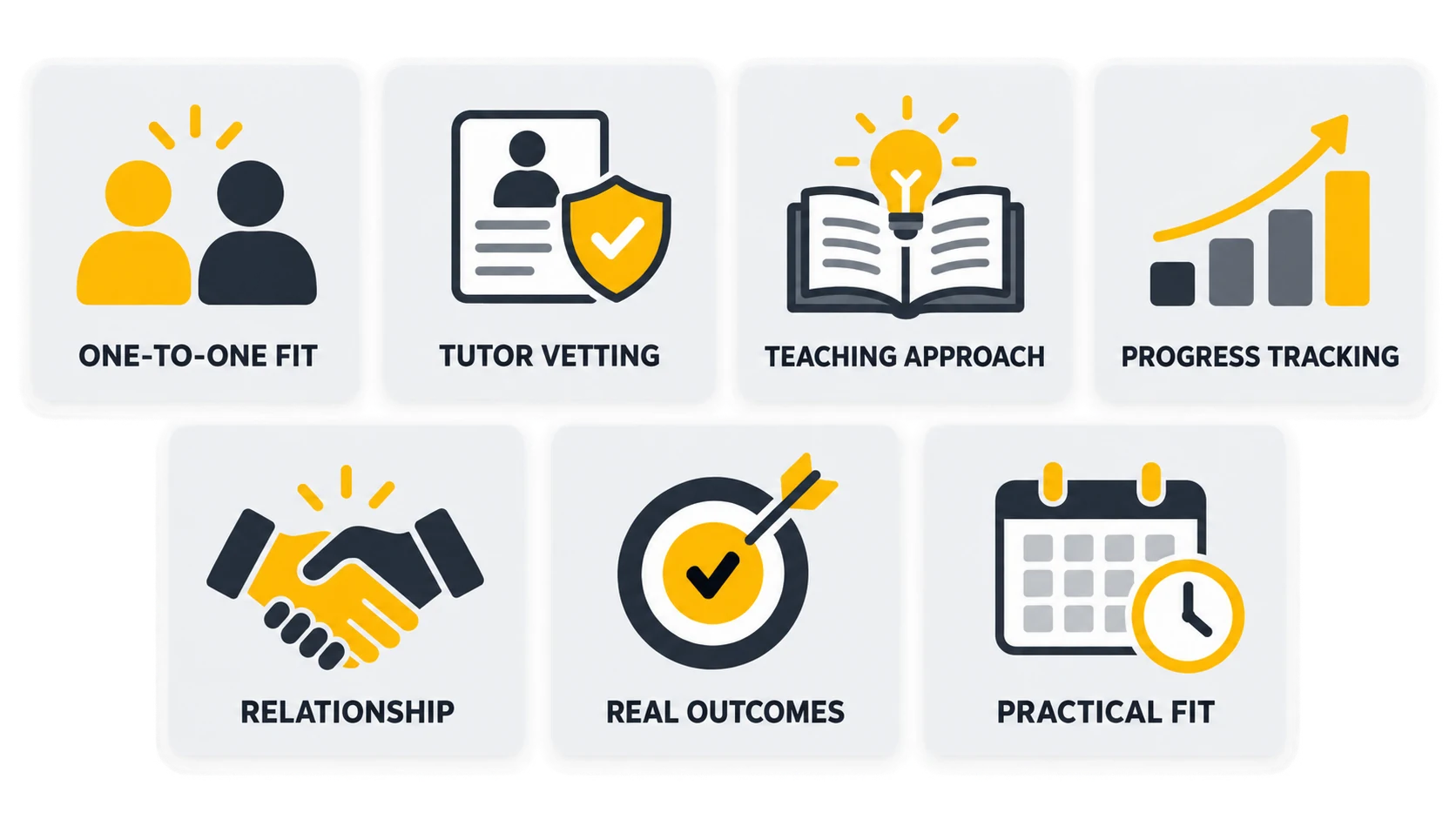
The Evidence-Based Checklist: Seven Areas to Evaluate
Here are the seven areas that separate an excellent online tutor from an average one. Assess every option against all seven — the lets you rate each on a simple scale so you can compare candidates fairly.
1. Individualization and Fit
This is the single most important factor, because it's the one the evidence supports most strongly.
Ask: Is this truly one-to-one, or is it a group in disguise? Some "personalized" programs are actually small groups, or a child working alone through pre-recorded videos with occasional check-ins. Neither delivers the individualized attention that makes tutoring effective. Real one-to-one means one tutor, focused entirely on your child, for the whole session.
Also ask: Is progression based on your child's actual skill, or on their age and grade? The best tutors meet a child exactly where they genuinely are and advance from there — a skill-based approach — rather than assuming every ten-year-old needs the same thing. This matters enormously for both advanced kids (who get bored by grade-level material) and struggling kids (who need to fill gaps before moving on). You can read more about how skill-based progression works on our Learning Pathways page.
2. Tutor Quality and Vetting
A tutoring service is only as good as the individual tutor in front of your child.
Ask how tutors are selected and vetted. What are their qualifications and their actual teaching ability — not just subject knowledge, but the skill to explain, adapt, and connect with a child? A brilliant expert who can't teach a ten-year-old is useless; a patient, skilled communicator who meets your child where they are is invaluable.
For online tutoring specifically, also confirm safeguarding and safety practices: background checks, session recording or monitoring policies, and clear online-safety standards. Any reputable service should be able to explain exactly how they keep children safe. If they can't, that's disqualifying.
3. Teaching Approach: Mastery Over Memorization
How a tutor teaches matters as much as who they are.
Look for an approach built on active, applied learning — where your child does, builds, and solves, rather than passively absorbs. The best tutoring builds genuine mastery (deep understanding your child can apply to new problems) rather than shallow memorization (recall that fades after the test).
A revealing question: What happens when my child gets stuck? A weak tutor simply gives the answer to keep things moving. A great tutor guides the child to work through it themselves — asking questions, building the child's own problem-solving muscles, turning frustration into a genuine breakthrough. That difference, repeated across hundreds of moments, is the difference between a child who becomes dependent and one who becomes capable.
4. Progress Tracking and Transparency
You're paying for progress, so you should be able to see it — clearly and specifically.
Ask exactly how a tutor measures and reports your child's progress. Beware vague reassurance: "She's doing great!" and "He's really engaged!" tell you nothing. Look instead for specific, skill-based reporting: "Your child has mastered this specific concept and can now apply it independently; next we're working on this." That level of transparency shows the tutor is genuinely tracking real learning, not just managing the relationship.
Radical transparency is a hallmark of a confident, effective tutor. If a service is cagey about how they'll show you progress, ask yourself why.
5. Engagement and Relationship
Motivation is the engine of learning, and it runs on relationship.
Ask: Will my child have the same tutor every session? Consistency lets a tutor truly know your child — their level, their interests, their quirks, what motivates them — and build the trust that keeps a child engaged over months. A rotating cast of tutors, however skilled, can't build that.
The best tutors also connect learning to what your child cares about — building projects and examples around their interests, so engagement comes naturally rather than through nagging. A child who's genuinely engaged learns faster and sticks with it; a bored child quietly checks out no matter how good the curriculum.
6. Real Outcomes and Evidence
Look for tutors who produce demonstrable results, not just certificates of attendance.
Ask what your child will actually be able to do or show after working with them. In coding, for instance, this means real projects your child built and can explain — a genuine portfolio — rather than a stack of completed tutorials or a completion certificate that proves only that they showed up. Real, visible outcomes are far more meaningful than any certificate, both for your child's genuine capability and for the future opportunities that portfolio can open.
7. Practical Fit: Technology, Scheduling, Communication, and Value
Finally, the practicalities that make tutoring sustainable week after week:
- Technology: Is the online platform reliable and easy for your child to use? Friction here erodes learning.
- Scheduling: Does it fit your family's real life, consistently?
- Communication: Will you receive clear, regular updates? Can you easily reach them with questions? (Our Contact page shows how we keep parents in the loop.)
- Value: Evaluate cost against outcomes, not just the hourly rate — more on this below.
The 7 Questions to Ask Any Online Tutor
Want a fast way to evaluate a tutor in a single conversation? Ask these seven questions. A great tutor will have clear, confident answers; a weak one will get vague or defensive. (Save these — they're your carousel-ready shortlist.)
1. Is it truly one-to-one, and will my child have the same tutor every session? Good answer: Yes to both. Red flag: Small groups, rotating tutors, or mostly self-paced videos.
2. How do you assess where my child actually is before you begin? Good answer: A genuine assessment of current skill. Red flag: They slot your child in by age or grade with no real evaluation.
3. How do you personalize to my child's specific level, pace, and interests? Good answer: Concrete, individualized adaptation. Red flag: A fixed curriculum everyone follows.
4. How will I know my child is making progress — what exactly will you show me? Good answer: Specific, skill-based reporting. Red flag: Vague reassurance and generic praise.
5. What are your tutors' qualifications, and how do you vet them and keep sessions safe? Good answer: Clear vetting, teaching ability, and safeguarding standards. Red flag: Evasiveness or no clear safety policy.
6. What will my child be able to do or show after working with you? Good answer: Real, demonstrable outcomes — a portfolio, working projects, genuine capability. Red flag: Certificates of completion as the main outcome.
7. What happens when my child gets stuck or struggles? Good answer: They guide the child to work through it and build real problem-solving skills. Red flag: They just give the answer, or gloss over the question.
Red Flags to Walk Away From
Some signals should end your consideration on the spot. Be wary of any online tutor who:
- Guarantees specific results ("straight A's in 30 days!"). Real learning doesn't come with guarantees, and anyone promising them is selling, not teaching.
- Can't clearly explain how they'll track progress. Transparency is non-negotiable.
- Is vague about safeguarding and online safety. This alone is disqualifying.
- Groups children by age rather than ability. A sign of a one-size-fits-all model.
- Relies mainly on passive content — videos to watch, worksheets to fill — with little genuine interaction.
- Rotates tutors so no one ever really knows your child.
- Focuses on certificates and badges rather than real, demonstrable skills.
- Pressures you to commit immediately with high-pressure sales tactics. A confident, effective tutor lets the quality of their approach speak for itself.
Any one of these warrants caution. Several together mean keep looking.
A Word on Cost: Measure Value, Not Just Price
It's tempting to compare tutors on hourly rate alone. Resist that.
The cheapest option is rarely the best value, and the most expensive isn't automatically the best either. What matters is cost per genuine outcome — per skill actually mastered, per real progress made.
A cheap group class or self-paced app that delivers little means you eventually pay again for another program, and another. A genuinely effective tutor who costs more per hour but produces real, lasting mastery in a fraction of the time is often dramatically better value. Always ask: what am I actually getting for this, and what will my child be able to do at the end? Judge the price against that, not against the number on the invoice.
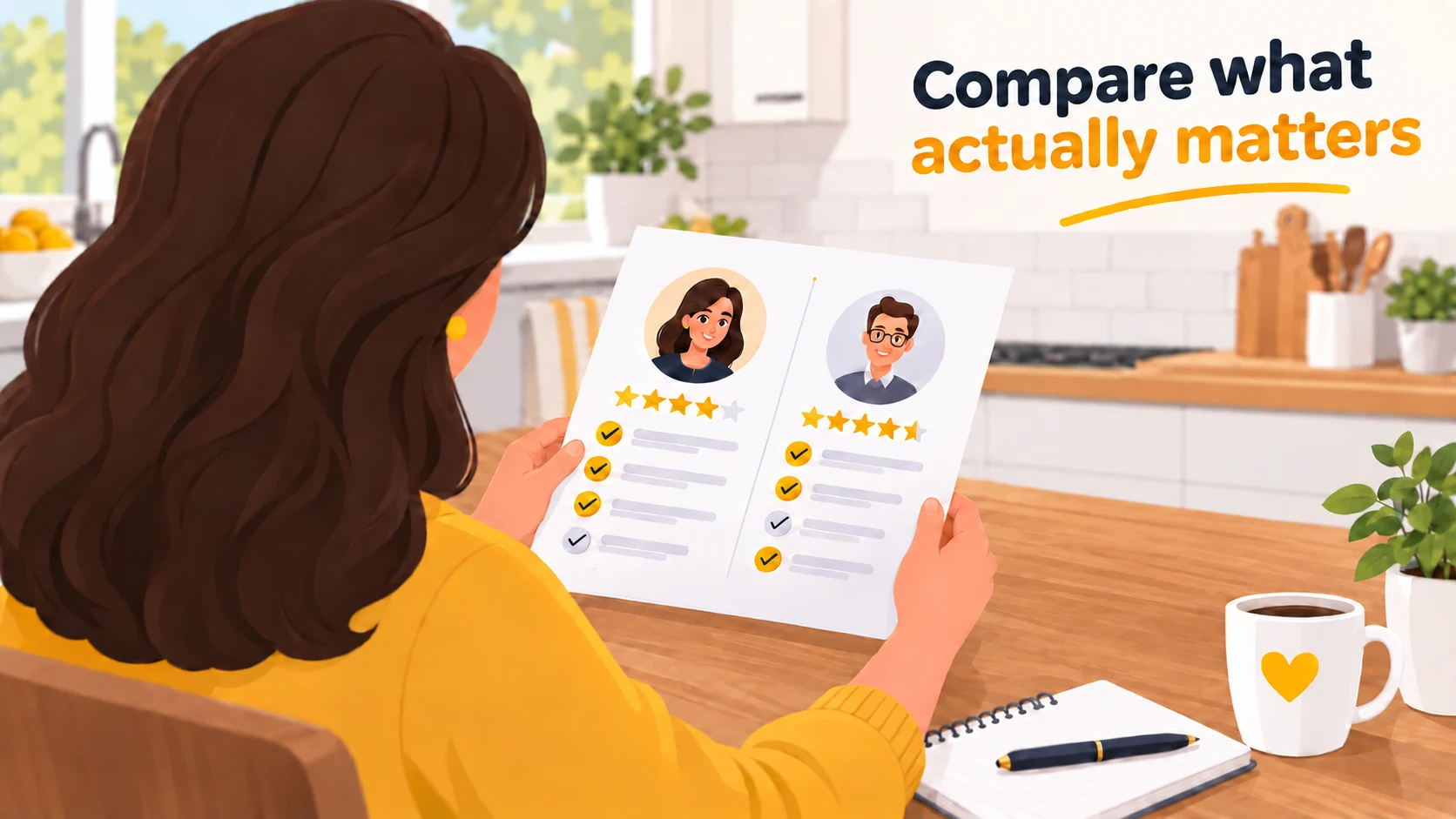
How to Use the Scorecard
Reading about criteria is one thing; comparing real options is another. That's exactly what the is for.
The scorecard turns everything above into a simple, side-by-side comparison tool. For each tutor you're considering, you rate them across the seven evaluation areas, note their answers to the seven key questions, and flag any red flags. When you've assessed two or three options this way, the right choice usually becomes obvious — because you're comparing what actually matters, not just which website looked nicest.
Download it, keep it beside you as you research and interview tutors, and let the evidence guide your decision.
The Bottom Line
Choosing an online tutor doesn't have to be a leap of faith. Behind the marketing and the polished websites, the things that make tutoring genuinely effective are well understood: real one-to-one individualization, skilled and vetted tutors, an active teaching approach that builds mastery, transparent progress tracking, a consistent relationship, demonstrable outcomes, and a practical fit for your family.
Evaluate every option against those criteria, ask the seven questions, watch for the red flags, and judge value by outcomes rather than hourly rate. Do that, and you'll choose with confidence — and give your child the accelerated progress and renewed confidence the right tutor can provide.
Your child deserves a tutor who's genuinely great, not merely plausible. Now you have the framework to tell the difference.
Download the Parent Scorecard — Then Put It to Use
Ready to compare your options like an expert? and use it to evaluate any tutor against the seven criteria that actually matter.
Then, if you'd like to see how our approach measures up, bring the scorecard to a free strategy call. We'll happily answer all seven questions, assess where your child genuinely stands, and show you exactly how our one-to-one, skill-based mentorship works — no pressure, just clarity.
Book your free strategy call today and choose your child's tutor with total confidence.
New here? Learn how it works, meet the team on our About Us page, or explore our skill-based Learning Pathways.
Personalized online tutoring and one-to-one mentorship for families in Bloomington, Monroe County, and around the world.
Related Articles

The Hidden Cost of 'Cheap' Coding Classes: Time You Can't Get Back
That $500 coding camp seems like a bargain — until you account for the 90 hours of commute, declining enthusiasm, and years of missing portfolio building. Here's the real math.
Read More
How to Evaluate Coding Programs: 10 Questions That Reveal Quality
Not all coding education is created equal. This guide gives you the exact questions to ask any program — and the red flags that reveal whether quality is real or just marketing.
Read More
Building Confident Girls in STEM: A Parent's Roadmap
Girls drop out of STEM at alarming rates between ages 10 and 14 — not from lack of ability, but from environment. Here's what works to build lasting confidence and capability.
Read MoreReady to Start Your Child's Journey?
Book a free 30-minute strategy call to discuss your child's potential.