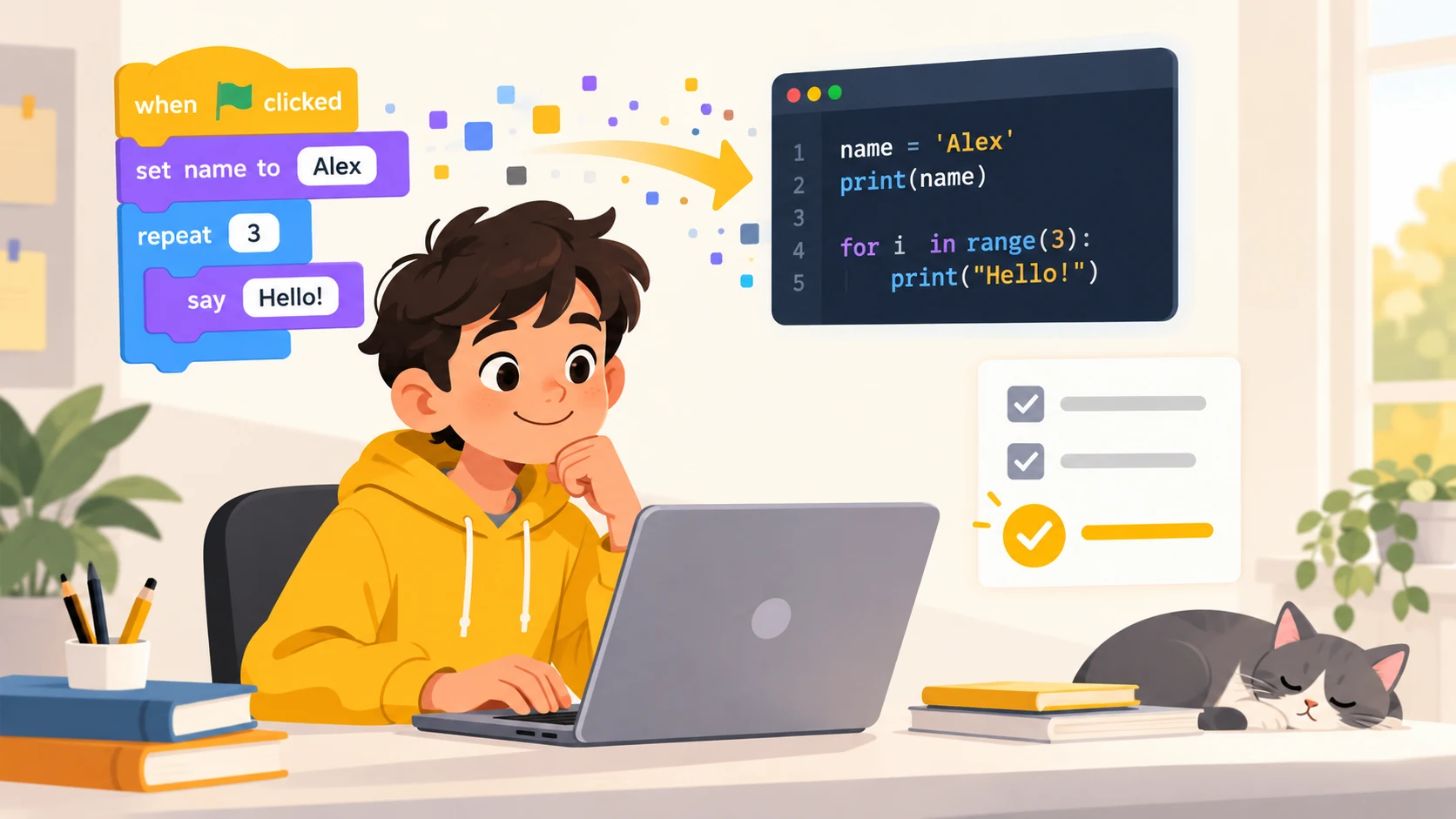
Your child has been coding with visual blocks for a while now, and they seem to be enjoying it. Maybe they've mentioned wanting to do "real" coding. Maybe you've heard that Python is the language professionals actually use, and you're wondering: is my child ready for that leap?
It's a great question — and an important one. Move a child to Python too early, and typing and syntax can frustrate them before they're ready. Wait too long, and a capable child gets bored coasting in visual blocks they've already outgrown. The magic happens when the timing is right: when a child has the foundations in place and is genuinely ready to write real code.
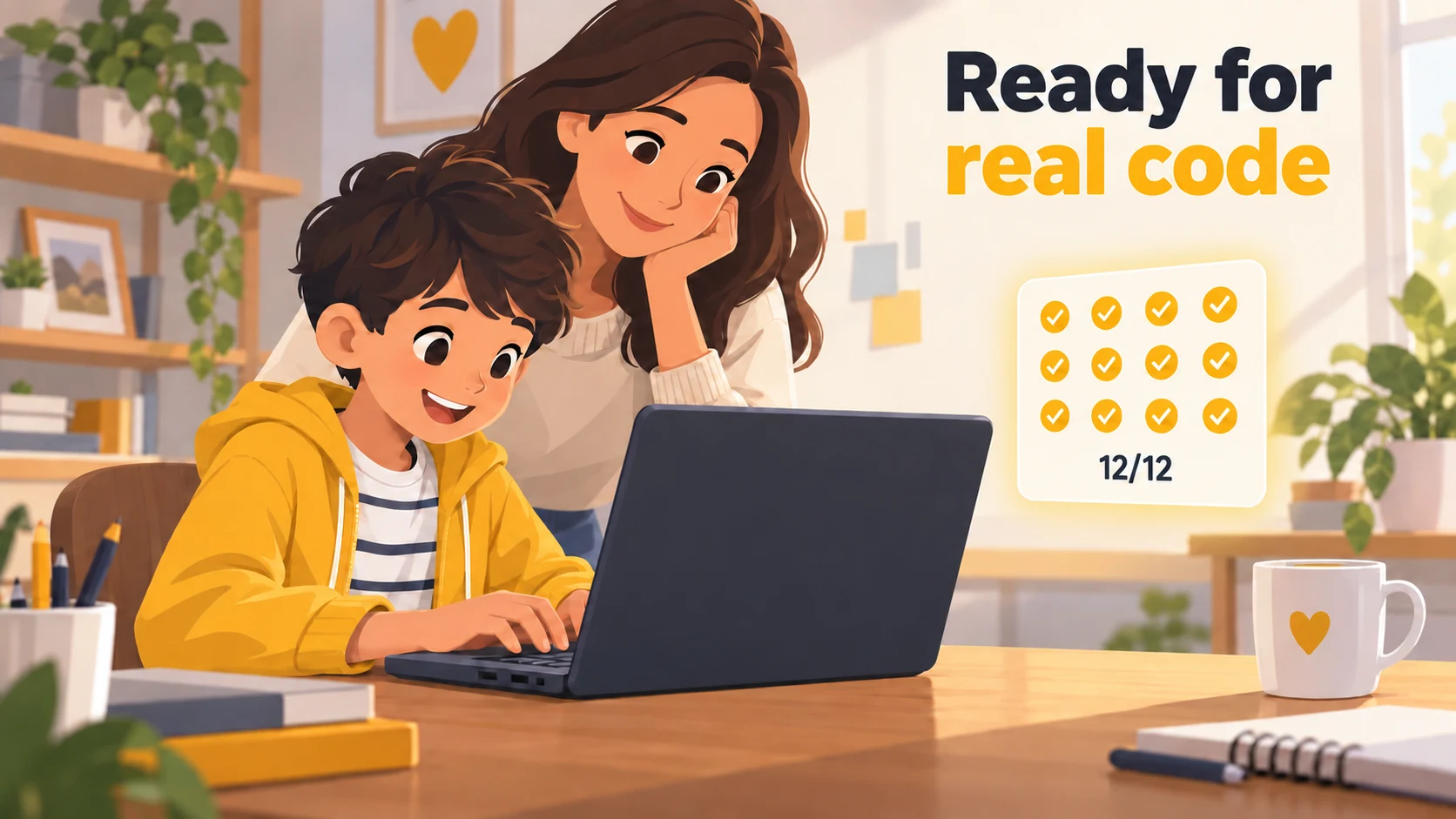
So how do you know? Readiness isn't about age — a motivated 9-year-old can be more ready than a reluctant 13-year-old. It's about specific, observable signs. Here are twelve of them, grouped into the areas that matter most, plus a simple way to check where your child stands.
First: Why Python, and Why Timing Matters
Before the signs, a quick word on why this particular leap is worth getting right.
Python is one of the best first real languages a child can learn. It was designed to be readable — it reads almost like plain English — which makes it unusually beginner-friendly. Yet it's also a genuine professional language, used in web development, data, automation, and artificial intelligence. Nothing your child learns in Python needs to be "unlearned" later; it's the real thing, scaled to their level. That's exactly why it anchors our Python Quest pathway.
The leap from visual blocks to Python is one of the most empowering moments in a young coder's journey — the moment they stop "playing at coding" and start thinking of themselves as a real programmer. But like any leap, it works best when the child is ready to make it. The twelve signs below tell you if that moment has arrived.
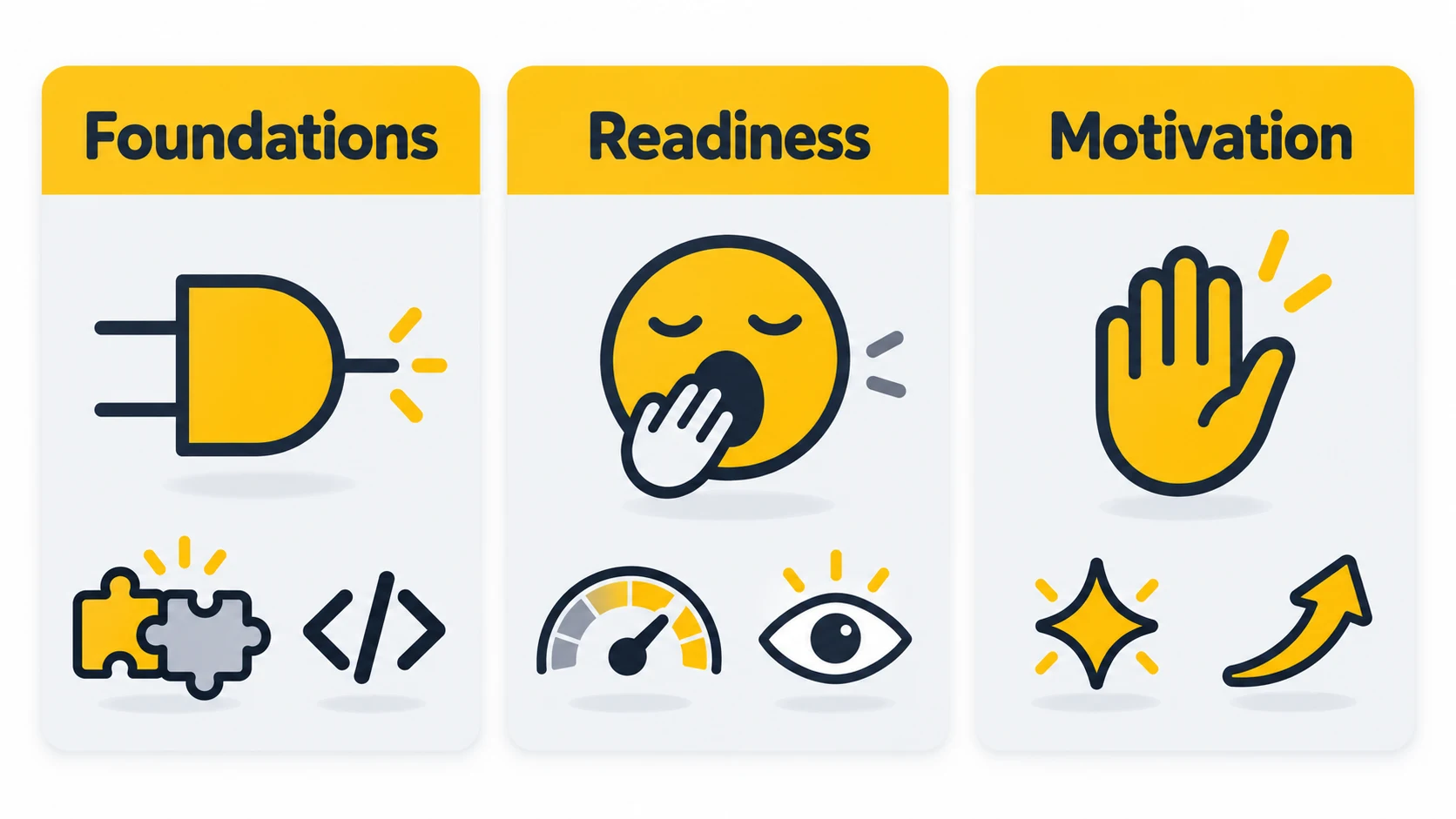
Foundational Signs: Do They Have the Building Blocks?
These first signs are about the core concepts and skills a child needs before real code will click.
1. They understand basic logic concepts. Your child grasps the ideas of sequencing (steps in order), loops (repeating actions), and conditionals ("if this, then that") — even if they've only met them through visual blocks. These concepts are the heart of Python, so meeting them first in a friendlier format is the ideal preparation.
2. They can read comfortably. Python is text-based, so reading fluency matters. A child who reads comfortably will handle written code, instructions, and error messages far more easily than one still working hard on reading itself.
3. They can type reasonably well. They don't need to be fast, but a child who's comfortable finding keys and typing simple text will find the transition far smoother than one for whom typing is still a struggle.
4. They understand cause and effect in their projects. When they build something in blocks, they understand why it behaves as it does — "it does this because I set it up that way." That grasp of cause and effect is exactly the thinking real code demands.
Readiness Signs: Have They Outgrown Where They Are?
These signs tell you a child isn't just able to move to Python — they're ready to, because they've outgrown their current stage.
5. They breeze through block-based projects. What used to challenge them is now easy. They finish quickly and without much effort. This ease is a clear signal they've mastered the current level and need a bigger one.
6. They're getting bored. Boredom in a previously enthusiastic coder rarely means they've lost interest in coding — it usually means they've outgrown the tool and need a fresh challenge. Boredom is often the single clearest readiness sign.
7. They're hitting the limits of what blocks can build. Your child starts imagining projects the blocks simply can't make — more complex, more ambitious, more "real." Their ambition has outgrown the tool's ceiling.
8. They're repeating themselves. They keep building slight variations of things they've already mastered, because there's nowhere new to go within their current tools. Without a new challenge, they'll plateau.
Motivation Signs: Do They Want the Leap?
Readiness isn't only about ability — motivation matters enormously, because the transition takes a little effort and a motivated child pushes through it happily.
9. They're asking about "real" coding. "Is this how real programmers code?" "Can I make a real app?" "How do actual websites get built?" These questions signal a child who's mentally ready to step up to the real thing.
10. They want to type real code. Many kids reach a point where dragging blocks starts to feel childish and they actively want to type code like an adult. When a child expresses that desire, they're telling you they're ready.
11. They're curious about how technology works. They wonder how their favorite apps or games are built, and they want to understand the "magic" behind the technology they use. That curiosity is powerful fuel for the Python journey — and it connects directly to the kind of logical thinking we develop in our Logic & Acumen work.
12. They stick with challenges instead of giving up. When something's hard, they're willing to keep trying rather than quitting immediately. This resilience matters, because Python — like all real coding — involves debugging and problem-solving. A child who can persist through a little frustration is ready to thrive.
How to Read the Signs
So how many signs does your child need? There's no rigid cutoff, but here's a useful way to think about it:
- Mostly foundational + a few readiness signs: Your child likely has the building blocks and is approaching readiness. They may be ready now, or very soon.
- Strong on readiness and motivation signs: This is the sweet spot. A child who's outgrown blocks and wants the leap is genuinely ready — waiting longer risks boredom.
- Missing several foundational signs: More time building fundamentals (comfortable reading and typing, solid grasp of logic) will make the eventual transition smoother and more successful. There's no rush, and no "behind."
Remember: this isn't about hitting a magic number or a magic age. It's about the overall picture. A child glowing with motivation but light on typing fluency might be ready with a little support on typing. A child strong on foundations but not yet bored might do well to keep building confidence first. The signs paint a picture — you're reading the whole thing, not counting checkboxes.
Our downloadable turns these twelve signs into a simple, structured tool, so you can assess your child's readiness clearly and know exactly what their next step should be.
What If They're Almost Ready?
If your child shows some signs but not others, that's not a "no" — it's a "nearly," and it's genuinely useful information.
A child who's motivated but still building foundational skills isn't blocked from Python; they just need the right support to bridge the gap. A child who has the foundations but isn't quite bored yet might benefit from slightly more challenging block projects before making the leap. The point of reading the signs isn't to pass or fail your child — it's to find their precise next step, whatever it is.
This is exactly why the transition works best with individual guidance. The leap from blocks to Python is the moment many kids get stuck if they're unsupported — typing and syntax can frustrate a child who was breezing through blocks, and a rough transition can dent their confidence. But with one-to-one mentorship, the move is timed perfectly and scaffolded carefully: the mentor recognizes the exact moment a child is ready, bridges the concepts they already know to their new Python equivalents, and turns those first inevitable errors into learning moments rather than reasons to quit. You can explore how these steps fit together on our Learning Pathways page.
The Bottom Line
Is your child ready for Python? The answer isn't written on their birth certificate — it's written in these twelve signs.
Look at whether they have the foundations (logic, reading, typing, cause-and-effect), whether they've shown the readiness signs of outgrowing their current tools (breezing through, boredom, hitting limits, repeating themselves), and whether they have the motivation (asking about real coding, wanting to type, curiosity, persistence). The overall picture will tell you clearly where they stand.
And if they're ready — or nearly there — the leap to Python is one of the most exciting and empowering steps in their whole coding journey. It's the moment they become a real programmer.
You just have to catch the moment. And now you know exactly what to look for.
Find Out If Your Child Is Ready
Want a clear answer? — a simple, structured tool built around all twelve signs — to see exactly where your child stands and what their ideal next step is.
If the signs point to ready, there's a perfect next move waiting. and explore Python Quest to see how we guide kids through the leap to real code — timed right, supported fully, and built around what your child loves.
Explore further: Python Quest · Learning Pathways · Logic & Acumen · Contact
One-to-one coding and AI mentorship for kids ages 8–15 — in Bloomington, Monroe County, and around the world.
Related Articles

The Hidden Cost of 'Cheap' Coding Classes: Time You Can't Get Back
That $500 coding camp seems like a bargain — until you account for the 90 hours of commute, declining enthusiasm, and years of missing portfolio building. Here's the real math.
Read More
How to Evaluate Coding Programs: 10 Questions That Reveal Quality
Not all coding education is created equal. This guide gives you the exact questions to ask any program — and the red flags that reveal whether quality is real or just marketing.
Read More
Building Confident Girls in STEM: A Parent's Roadmap
Girls drop out of STEM at alarming rates between ages 10 and 14 — not from lack of ability, but from environment. Here's what works to build lasting confidence and capability.
Read MoreReady to Start Your Child's Journey?
Book a free 30-minute strategy call to discuss your child's potential.