It's the question quietly nagging at thoughtful parents everywhere: If artificial intelligence can now write code, is it even worth my child learning to code at all?
It's a fair question, and it deserves a fair answer — not a defensive one. AI coding tools are genuinely impressive. They can generate working code from a plain-English description, fix bugs, and handle routine programming tasks that used to take a human hours. If a machine can do all that, it's completely reasonable to wonder whether teaching a child to code is preparing them for a world that no longer exists.
Here's the honest answer, and it's more interesting than a simple yes or no: AI changes what is worth learning, but it makes the underlying skills more valuable, not less. The child who learns to code the right way in the AI era isn't learning an obsolete skill. They're learning exactly the things AI can't do — the things that will matter most in a world full of AI.
Let's think this through clearly, because getting it right shapes how you prepare your child for the future they'll actually inherit.
Let's Be Honest About What AI Can Do
Any useful answer has to start by taking AI seriously rather than dismissing it.
Modern AI tools really can write code. Describe what you want, and they'll produce a working function. They can explain code, translate between languages, spot and fix certain bugs, and automate a great deal of the routine, repetitive programming that once filled a junior developer's day. This is real, and it's not going away — it's going to get more capable.
So yes: the specific act of typing out syntax from memory — the rote mechanical part of coding — is becoming less valuable. A child who learns coding as "memorize this syntax and reproduce it on command" is, indeed, learning something AI can increasingly do for them.
But here's the thing most people miss: typing syntax was never the hard part of coding, or the valuable part. It was always the easy part. The hard, valuable part is everything around the code — and that's exactly what AI can't do for you.
What AI Can't Do (And Why It Matters More Than Ever)
Think about what it actually takes to build something real with technology. Writing the code is one small slice. The rest looks like this:
Deciding what to build in the first place. AI can write code, but it can't tell you what problem is worth solving or what to create. That judgment — seeing a need in the world and deciding what should exist to meet it — is entirely human.
Knowing whether the AI's output is any good. This one is critical. AI frequently produces code that looks right but is subtly wrong, inefficient, insecure, or doesn't actually do what you needed. Someone has to understand what the AI produced well enough to judge it, catch its mistakes, and fix what's broken. A person who can't read and understand code is completely at the mercy of a tool that's confidently wrong a meaningful fraction of the time.
Breaking a big, vague problem into clear pieces. Real problems arrive messy and ill-defined. Turning "our club's scheduling is chaos" into a precise plan an AI could even help with requires structured, computational thinking — decomposition, logic, sequencing. That's a human skill, and it's the foundation of directing AI effectively.
Directing the AI well. Getting good results from AI coding tools requires understanding the problem deeply enough to ask for the right thing, evaluate what comes back, and iterate. The better you understand code and computational thinking, the better you can direct AI. The person who understands nothing gets nothing useful out of it.
Putting the pieces together into something that actually works. AI can generate components, but architecting a real, complete system — deciding how the parts fit, handling the edge cases, making it genuinely work for real people — remains human work.
Notice the pattern: AI handles the mechanical part (writing lines of code) while every part that requires understanding, judgment, and direction remains firmly human. And here's the key insight — those human parts are exactly what a good coding education builds. AI hasn't made coding education obsolete. It's revealed which parts of it were always the point.
The Shift: From Writing Code to Directing It
Here's the most useful way to frame what's changed.
In the past, being valuable in technology meant being able to write code. In the AI era, the value shifts toward being able to understand, direct, and judge code — to be the human who knows what to build, can tell the AI what to do, and can evaluate whether what comes back is any good.
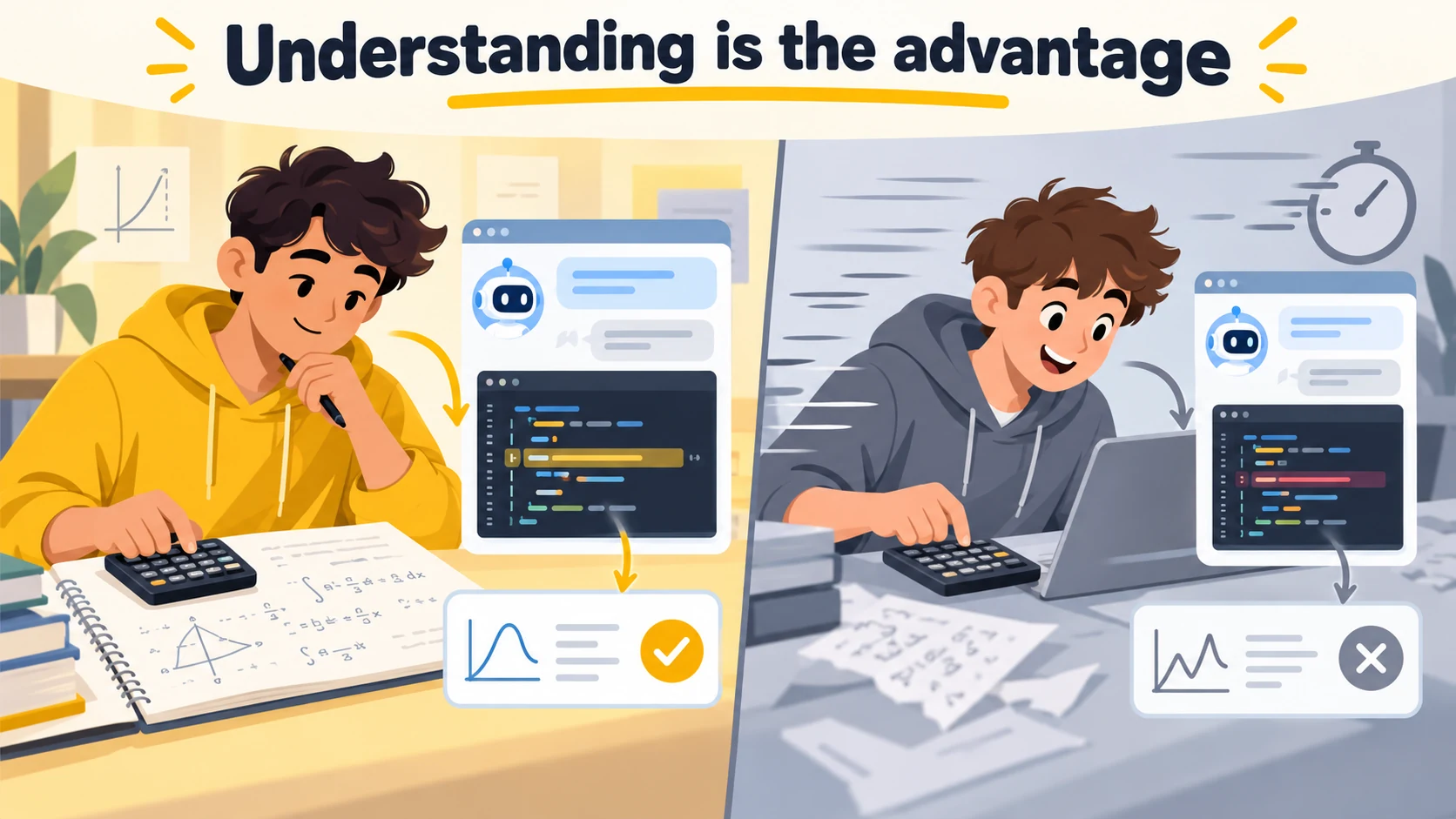
Think of it like this: AI is becoming an incredibly powerful tool, a bit like a calculator for coding. But a calculator didn't make math education pointless — it made understanding math more important than fast hand-calculation. The person who understands math uses the calculator to do far more. The person who doesn't understand math just gets wrong answers faster.
The same is true here. AI coding tools are enormously powerful in the hands of someone who understands what they're doing — and nearly useless, or even dangerous, in the hands of someone who doesn't. The goal for your child, then, isn't to compete with AI at typing code. It's to become the kind of person who can direct AI with understanding and judgment. That's a far more valuable — and far more future-proof — position.
The Six Durable Skills for the AI Era
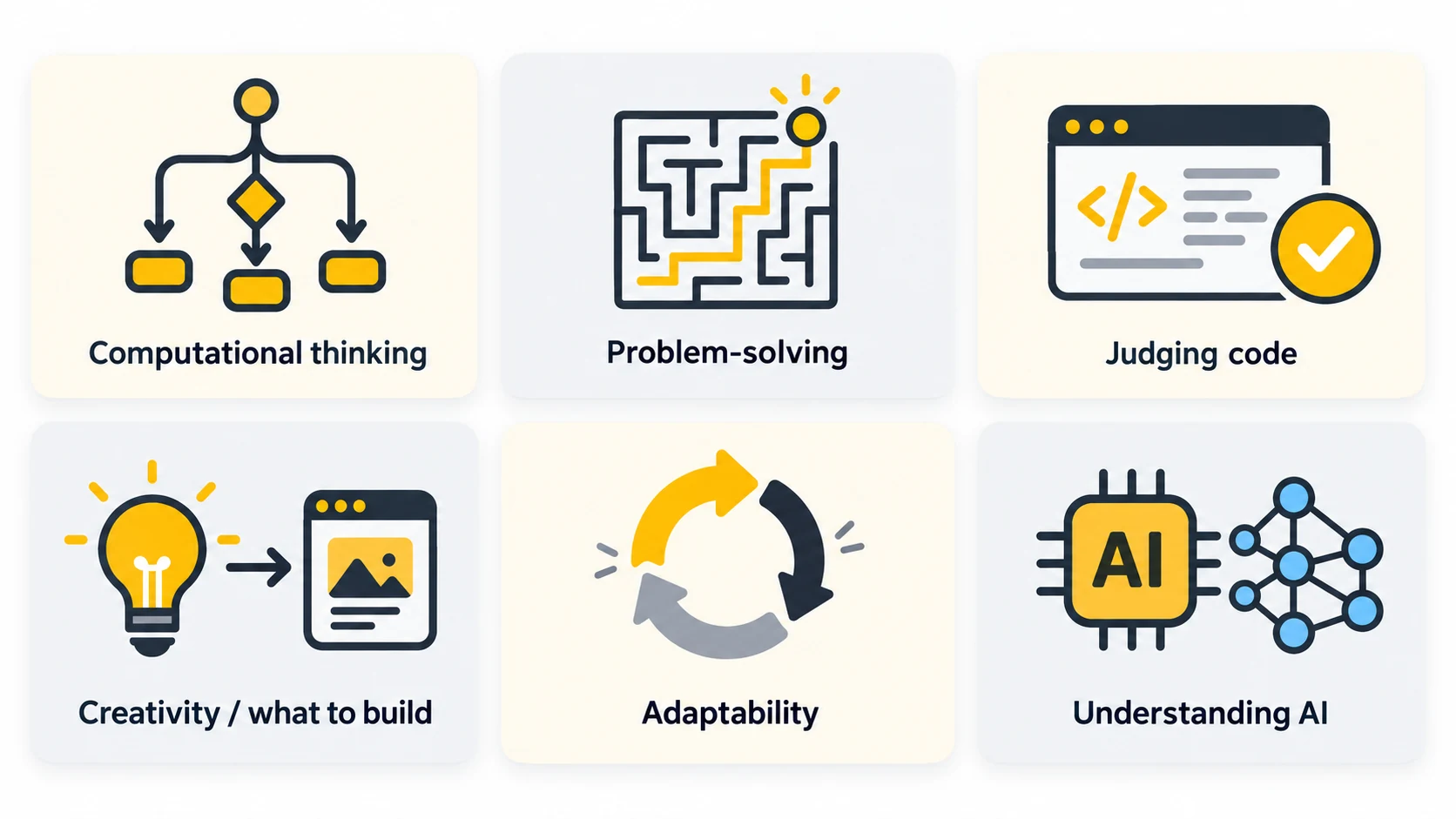
So what should children actually learn now? The skills that don't get automated away — the durable ones that make a person the director of AI rather than someone replaced by it. Here are six that matter most.
1. Computational thinking. The ability to break complex problems into clear, logical steps. This is the foundation of both coding and directing AI, and it's a way of thinking, not a syntax to memorize. It doesn't become obsolete — it becomes the core skill.
2. Genuine problem-solving. Knowing how to approach a problem you've never seen before: analyzing it, planning an approach, working through obstacles. AI can execute solutions; deciding how to solve remains human.
3. The ability to read and judge code. Not necessarily writing every line by hand, but understanding code well enough to evaluate whether it's correct, safe, and good. In an AI world where machines produce code constantly, the ability to judge that output is one of the most valuable skills a person can have.
4. Creativity and knowing what to build. The vision to imagine what should exist — what problem to solve, what to create. AI builds what it's told; humans decide what's worth building. This creative, directional judgment becomes more valuable, not less.
5. Resilience and adaptability. The technology will keep changing, faster than ever. The child who learns how to learn, who's comfortable with challenge and change, will adapt to whatever tools come next. This adaptability is perhaps the ultimate future-proof skill.
6. Understanding AI itself — and using it responsibly. As AI becomes woven into everything, understanding how it works — what it can and can't do, where it fails, how to use it safely and ethically — becomes essential literacy. A child who understands AI from the inside will wield it wisely; one who treats it as magic will be misled by it.
Look at that list and notice: none of these is "memorize syntax." Every one is a durable, human, understanding-based skill. And every one is exactly what a genuine coding and AI education develops. Our downloadable helps you gauge where your child stands on these skills — and how to help them use AI tools safely and wisely.
Why Learning to Code Still Builds All of This
Here's the part that ties it together: learning to code — properly — is still one of the very best ways to build every one of those six durable skills.
You don't develop computational thinking, problem-solving, or the ability to judge code in the abstract. You develop them by actually building things. When a child learns to code, they're not just learning syntax (the part AI can help with) — they're learning to break down problems, reason logically, debug systematically, and understand how software actually works. Those are precisely the skills that let them direct AI effectively.
In fact, understanding code is what makes someone a powerful user of AI coding tools rather than a helpless one. The child who genuinely understands programming can look at what an AI produces and think "that's not quite right, here's why, let me fix it." The child who never learned can only copy, paste, and hope. That understanding is the difference between commanding the tool and being at its mercy.
And this is exactly why the modern goal isn't to raise a child who can out-type a machine. It's to raise a child who understands technology deeply enough to direct it — who can partner with AI, evaluate it, and build things that matter. That's the vision behind our AI with Python pathway, where kids learn both real coding foundations and how to understand and work with artificial intelligence itself — building exactly the durable skills the AI era rewards. It starts with genuine coding foundations in Python Quest and grows from there.
Learning With AI, Not Against It
There's one more shift worth naming. The best coding education in the AI era doesn't pretend AI doesn't exist, nor does it fear it. It teaches children to work with AI thoughtfully — to use it as the powerful tool it is, while building the understanding and judgment to use it well.
That means learning when AI helps and when it misleads, how to check its work, how to use it to learn faster rather than to avoid thinking, and how to stay in the driver's seat. A child taught this way isn't threatened by AI — they're empowered by it. They grow up fluent in the most important tool of their era, and grounded in the understanding that lets them use it wisely.
This balanced, understanding-first approach is exactly what individual mentorship provides and generic content can't. A mentor can teach a child not just to code, but to think — to judge AI's output, to direct it well, to build genuine understanding beneath the tools. You can see the full range of how we prepare kids for this future across our Learning Pathways and Services.
The Bottom Line
So — AI can write code. What should children learn now?
Not the mechanical part AI is taking over: memorizing and typing syntax. Instead, the durable, human skills that AI makes more valuable — computational thinking, real problem-solving, the ability to read and judge code, creativity about what to build, adaptability, and a genuine understanding of AI itself.
And the best way to build every one of those skills is still to learn to code properly — not as rote syntax, but as a way of thinking and building that turns a child into someone who can direct technology rather than be displaced by it.
The future doesn't belong to people who can do what AI does. It belongs to people who understand deeply enough to command it. That's what your child should be learning now — and it's more worth learning than ever.
Prepare Your Child to Lead in the AI Era
The children who thrive won't be the ones competing with AI — they'll be the ones who understand and direct it. Explore Introduction to AI with Python to see how your child can build both real coding foundations and genuine AI understanding: the durable skills that matter most now.
Start with our free to see where your child stands and how to help them use AI wisely and safely.
Explore Introduction to AI with Python and give your child the skills to command the technology of their future.
Explore further: AI with Python · Python Quest · Learning Pathways · Services
One-to-one coding and AI mentorship for kids and teens — in Bloomington, Monroe County, and around the world.
Related Articles

AI and the Future of Kids' Coding Careers: What Parents Need to Know in 2026
AI now writes code at human-junior level. Does that make learning to code obsolete? The opposite. Here's why deep logical thinking matters more than ever — and what skills will compound for the next 20 years.
Read More
What Premium Online Tutoring Should Actually Look Like in 2026
Most online tutoring is just a webcam pointed at a teacher. Premium online tutoring is something fundamentally different. Here's the standard you should expect.
Read More
Why Your Gifted Child is Bored in Coding Class (And What To Do About It)
The heartbreaking pattern repeats worldwide: a brilliant nine-year-old masters programming concepts in two weeks, then sits through ten more weeks of review. Here's why age-based curricula systematically fail gifted learners.
Read MoreReady to Start Your Child's Journey?
Book a free 30-minute strategy call to discuss your child's potential.