Online AI Classes with Python for Kids & Teens
A practical introduction to artificial intelligence using Python
Learning Journey
48 Classes
Learning Style
Interactive Learning
Learn • Practice • Grow
Build Skills with Confidence
Discover
What's This Course About?
A fun learning journey designed to help children explore, understand and confidently apply new skills.
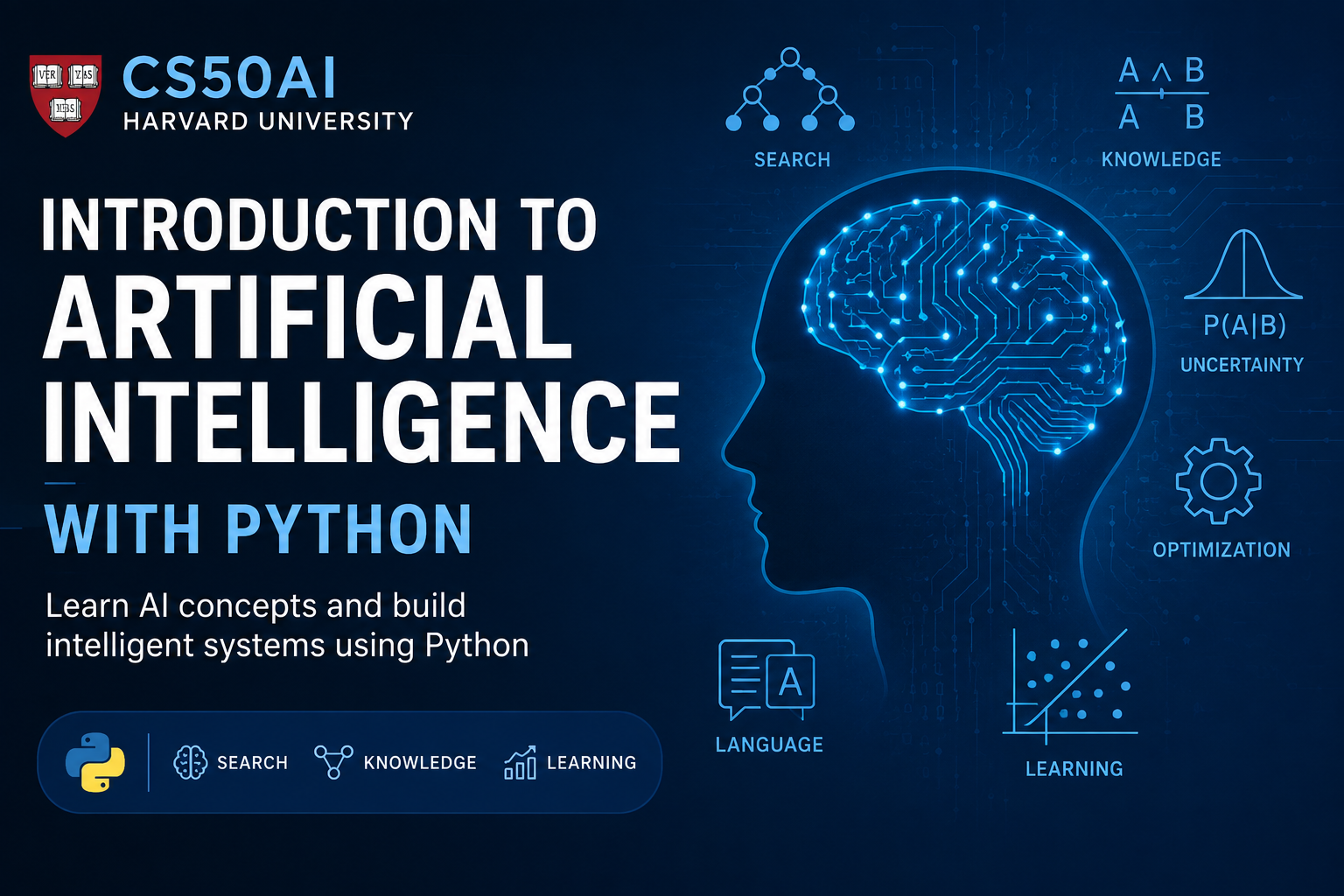
Introduction to Artificial Intelligence
What Your Child Will Learn
Understand what artificial intelligence is, how intelligent agents solve problems, and how Python can be used to build AI systems.
Search Algorithms
What Your Child Will Learn
Learn how AI systems search through possible solutions using depth-first search, breadth-first search, greedy best-first search, and A* search.
Adversarial Search
What Your Child Will Learn
Understand how AI makes decisions in competitive environments using minimax, game trees, and alpha-beta pruning.
Knowledge Representation
What Your Child Will Learn
Learn how AI systems represent facts and information using propositional logic, knowledge bases, and logical statements.
Logical Inference
What Your Child Will Learn
Understand how AI can derive new information from existing knowledge using model checking, inference, logical equivalence, and resolution.
Probability and Uncertainty
What Your Child Will Learn
Learn how AI systems handle incomplete or uncertain information using probability, conditional probability, and Bayes' rule.
Bayesian Networks
What Your Child Will Learn
Understand how Bayesian networks represent relationships between variables and use probability to reason about uncertain situations.
Probabilistic Inference
What Your Child Will Learn
Use joint probability, conditional probability, sampling, and probabilistic reasoning to make predictions from uncertain data.
Optimization
What Your Child Will Learn
Learn how AI systems find good solutions efficiently using local search, hill climbing, simulated annealing, and optimization techniques.
Constraint Satisfaction
What Your Child Will Learn
Understand constraint satisfaction problems and use backtracking search to solve problems with multiple possible combinations.
Introduction to Machine Learning
What Your Child Will Learn
Understand how computers learn from data and explore the differences between supervised, unsupervised, and reinforcement learning.
Classification
What Your Child Will Learn
Learn how AI systems classify data using algorithms such as nearest-neighbor classification, perceptrons, and support vector machines.
Regression and Prediction
What Your Child Will Learn
Understand regression, loss functions, and how machine learning models can make numerical predictions from data.
Overfitting and Regularization
What Your Child Will Learn
Learn why machine learning models can perform poorly on new data and how regularization and other techniques help improve generalization.
Reinforcement Learning
What Your Child Will Learn
Understand how AI agents learn by interacting with an environment, receiving rewards, and improving their decisions through experience.
Neural Networks
What Your Child Will Learn
Learn how artificial neural networks work, including neurons, layers, activation functions, weights, and biases.
Gradient Descent and Backpropagation
What Your Child Will Learn
Understand how neural networks learn by adjusting their parameters using gradient descent and backpropagation.
Deep Learning
What Your Child Will Learn
Explore deeper neural network architectures and understand how multiple layers can learn increasingly complex patterns from data.
Convolutional Neural Networks
What Your Child Will Learn
Learn how convolutional neural networks process images and identify visual patterns such as shapes, edges, and objects.
Natural Language Processing
What Your Child Will Learn
Understand how AI systems process human language and explore techniques for analyzing and interpreting text.
Language Models
What Your Child Will Learn
Learn how language models represent and predict sequences of words using techniques such as n-grams and probabilistic models.
Text Classification
What Your Child Will Learn
Build systems that classify and analyze text using techniques such as Naive Bayes and TF-IDF.
AI Projects and Practical Applications
What Your Child Will Learn
Apply AI concepts through practical Python projects involving search, games, probability, machine learning, neural networks, and natural language processing.
Final AI Project and Presentation
What Your Child Will Learn
Combine the concepts learned throughout the course to build and present a practical AI project while explaining the decisions and techniques used.
A Better Way to Learn
Learning That Kids Look Forward To
Lessons are designed to keep children involved, curious and confident instead of simply watching and memorising.
Interactive Learning
Children learn by exploring concepts, solving activities and actively participating.
Made for Kids
Concepts are presented in a simple and engaging way that helps young learners stay interested.
Confidence Building
Step-by-step learning helps children strengthen skills and feel proud of their progress.
Is this course right for your child?
Learners interested in exploring artificial intelligence through Python.
Starting level and prerequisites
Discuss Python experience and mathematical readiness before enrolling. The consultation can identify foundations to review.
An example learning activity
Work through a course example, compare its output with expectations and discuss why an AI result needs checking. This illustrates a possible activity, not a guaranteed project or result.
Learning goals
Build introductory understanding of AI concepts and their limitations through guided practice. Progress depends on the starting point, practice and learning needs.
How do online lessons work?
One-to-one lessons give students time to ask questions, try examples and explain their reasoning. Discuss the online setup, lesson arrangements and availability during your consultation.
How can parents follow progress?
Agree with the team on how progress will be communicated. Useful questions include what your child can explain independently, where guidance is still needed and what to practice next.
Can school tutoring follow our curriculum?
Share your current unit and school requirements. School support can follow that sequence while adapting the pace and revisiting foundations. Coding and AI enrichment can follow the published course topics.
Use the parent checklist for choosing online tutoring · Explore learning plans
Ready to Start?
Begin Your Child's Learning Adventure
Discover how engaging, guided and interactive learning can help your child build skills with confidence.