
Algebra 1 is a turning point. For many students, it's the first math course that feels genuinely abstract — the moment numbers give way to letters, and "find the answer" becomes "solve for the unknown." Handled well, it opens the door to all of higher math. Handled poorly, it becomes the wall a student hits and never quite recovers from.
Here's what makes the difference, and it's almost entirely hidden: whether a student truly has the prerequisite skills before the course begins. Algebra doesn't teach these foundations — it assumes them. A student who arrives shaky on the underlying arithmetic and number sense doesn't just struggle with one topic; they struggle with everything, because algebra builds relentlessly on skills that were supposed to already be solid.
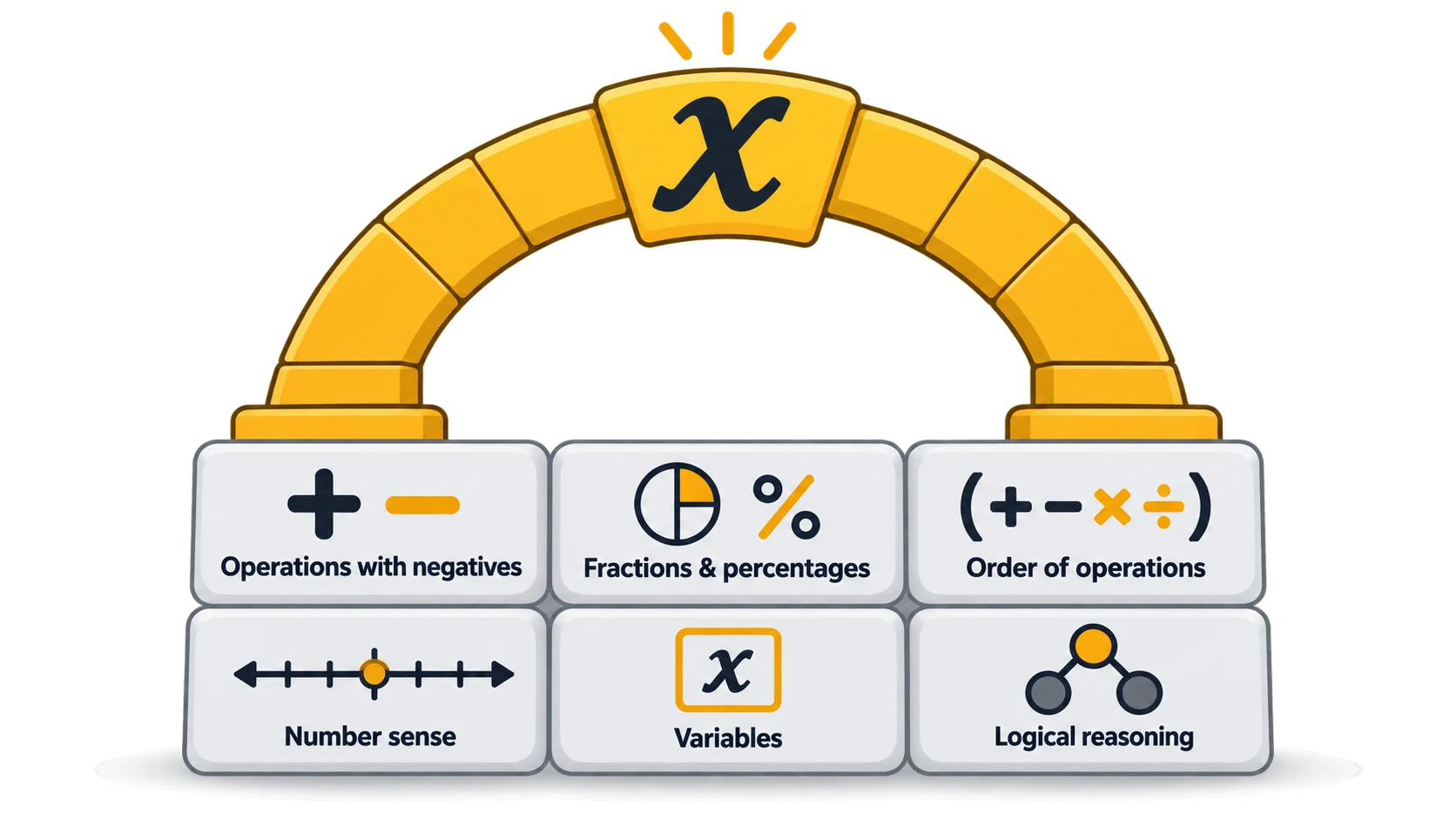
The good news is that readiness is checkable in advance. You don't have to wait for the first failing test to discover a gap. Below are the six skill areas that matter most before Algebra 1 — what to check, why each one matters, and how to tell whether your child genuinely has it or just appears to.
Why Readiness Matters More Than the Grade Ahead of It
Before the checklist, one crucial point: a good grade in the previous math course is not proof of Algebra 1 readiness.
Why? Because, as many parents discover the hard way, a child can earn good grades by memorizing procedures without truly understanding the concepts underneath. Those memorized steps are enough to pass a straightforward test — but algebra doesn't reward memorized steps. It demands genuine understanding of why the math works, because it constantly asks students to apply familiar ideas in unfamiliar, abstract ways.
So a student can finish pre-algebra with a solid grade and still be missing the real conceptual foundations Algebra 1 requires. The grade measured whether they could reproduce procedures. Readiness is about whether they genuinely understand. Those are different things — which is exactly why a dedicated readiness check, rather than a backward glance at last year's report card, is worth doing.
With that in mind, here are the six areas to check.
Skill 1: Fluency With the Four Operations (Including Negatives)
What to check: Can your child comfortably add, subtract, multiply, and divide — including with negative numbers — without hesitation or a calculator for the basics?
Why it matters: Algebra is arithmetic wearing letters. Every equation your child solves will involve these operations, often several times in a single problem. If the basic arithmetic isn't automatic, the student burns all their mental energy on the calculation and has nothing left for the actual algebra. Negative numbers matter especially: algebra is full of them, and a student shaky on negatives (−5 − 3, or −4 × −2) will make constant, confidence-destroying errors.
The understanding check: Don't just check whether they get answers right — check whether they're fluent and confident. Slow, effortful, or error-prone arithmetic is a gap worth closing before the course starts, not during it.
Skill 2: Fractions, Decimals, and Percentages
What to check: Can your child confidently work with fractions (adding, subtracting, multiplying, dividing, simplifying), convert between fractions, decimals, and percentages, and genuinely understand what these represent?
Why it matters: Fractions are where many algebra students quietly fall apart. Algebra is saturated with them — coefficients, ratios, rational expressions, solving equations that produce fractional answers. A student who fears or fumbles fractions will find algebra a constant uphill battle, because there's almost no escaping them.
The understanding check: This is a place where memorized procedures often hide a shaky foundation. Ask your child not just to compute, but to explain: why do you need a common denominator to add fractions? What does 3/4 actually mean? A student who can only follow steps without understanding will struggle when algebra uses fractions in unfamiliar ways.
Skill 3: Order of Operations and Working With Expressions
What to check: Can your child correctly apply the order of operations to evaluate a multi-step expression, and handle expressions with parentheses and exponents accurately?
Why it matters: Algebra involves manipulating expressions constantly, and every one of those manipulations depends on rock-solid order-of-operations understanding. A student who's unsure whether to multiply or add first will misread and mis-solve algebraic expressions from day one. This is a foundational grammar of math — get it wrong, and everything built on top of it comes out wrong too.
The understanding check: Give them a multi-step expression with parentheses, exponents, and several operations. Watch whether they work through it confidently and in the right order — and, again, whether they understand why the order matters, rather than just reciting a memorized acronym.
Skill 4: Number Sense and Properties
What to check: Does your child have genuine "number sense" — an intuitive feel for how numbers behave? Do they understand properties like the distributive property (that 3 × (4 + 2) equals 3 × 4 + 3 × 2)?
Why it matters: This is one of the most underrated prerequisites. Number sense is what lets a student estimate, spot when an answer is obviously wrong, and understand why algebraic manipulations are valid. The distributive property in particular is the direct foundation for expanding expressions and, later, factoring — core Algebra 1 skills. A student who truly understands these properties finds algebra logical; a student without them finds it a series of arbitrary rules to memorize.
The understanding check: Ask why the distributive property works, or have them estimate an answer before calculating. Strong number sense shows up as flexibility and intuition; its absence shows up as rigid, rule-following calculation with no sense of whether an answer is reasonable. Building exactly this kind of flexible mathematical thinking is central to our Logic & Acumen work.
Skill 5: Working With Variables and Simple Equations
What to check: Is your child comfortable with the idea of a letter standing for an unknown number? Can they handle simple equations like x + 5 = 12, and understand what "solving for x" actually means?
Why it matters: This is the conceptual leap at the very heart of algebra — from concrete numbers to abstract symbols. A student who understands that a variable is simply a stand-in for an unknown value, and that solving means finding that value while keeping the equation balanced, has grasped the central idea Algebra 1 is built on. A student for whom letters-as-numbers feels mysterious will struggle with nearly everything that follows.
The understanding check: Beyond solving a simple equation, check the concept. Can they explain what x represents? Do they understand that whatever you do to one side of an equation, you must do to the other? This conceptual grasp matters far more than the ability to solve any single equation.
Skill 6: Logical Reasoning and Problem-Solving
What to check: Can your child think through a multi-step problem logically? When they hit a word problem or an unfamiliar question, can they reason toward an approach rather than freezing?
Why it matters: Algebra isn't just computation — it's structured reasoning. Students constantly have to translate word problems into equations, decide which steps to take, and work logically toward a solution. A student with strong logical reasoning adapts to unfamiliar problems; a student without it can only handle problems that look exactly like ones they've seen before. Since algebra is full of novel problems, this skill is essential.
The understanding check: Give them an unfamiliar, multi-step problem and watch how they approach it. Do they break it down and reason through it, or do they give up the moment it doesn't match a memorized pattern? The ability to reason through the unfamiliar is one of the strongest predictors of algebra success — and one of the most overlooked.
How to Use These Six Skills
Reading through these areas, you may already have a sense of where your child is solid and where there might be gaps. To make that assessment concrete, our downloadable turns all six skill areas into specific, checkable questions — so you can move from a general feeling to a clear, area-by-area picture of your child's readiness.
As you assess, keep two things in mind:
Look for understanding, not just right answers. Throughout all six areas, the theme is the same: a child can often produce correct answers through memorized procedures while missing the genuine understanding algebra demands. Whenever possible, ask why. The child who can explain their reasoning is far more ready than the one who can only follow steps.
A gap isn't a verdict — it's a head start. If you find weak areas, that's genuinely good news: you've found them before the course begins, when there's time to close them. A student who shores up shaky fractions or negative numbers over a few weeks enters Algebra 1 on solid ground instead of discovering the gap through a failing test in October. Finding a gap early is a gift, not a problem.
Why Closing Gaps Works Best One-to-One

Here's the challenge with prerequisite gaps: they're specific to each child. One student's weak spot is fractions; another's is negative numbers; another's is the conceptual leap to variables. A generic review course treats everyone the same, spending time on skills a child already has while rushing past the exact gap that matters most for them.
Closing gaps efficiently requires meeting a child exactly where they are — which is what one-to-one attention makes possible. A dedicated tutor can pinpoint the specific prerequisite a student is missing, understand why the understanding broke down, and rebuild that particular foundation before the course begins. Instead of a broad review that mostly repeats what a child already knows, they get targeted work on the precise skills that will make or break their Algebra 1 experience. You can see how this targeted approach works on our How It Works page — and it applies directly in our Algebra 1 mentorship, where readiness comes first.
The Bottom Line
Algebra 1 success is decided, to a remarkable degree, before the course even begins — by whether a student genuinely has the six prerequisite skills it quietly assumes: fluent arithmetic with negatives, confident work with fractions and percentages, solid order of operations, real number sense, comfort with variables and simple equations, and logical problem-solving.
A good grade in last year's math isn't proof of these. Genuine understanding is. So check the foundations now, while there's time to strengthen any weak spots — because a student who enters Algebra 1 truly ready doesn't just survive the course. They build the confidence and mastery that carries them through all the math that follows.
Find the gaps early. Close them before the course starts. And turn algebra from a wall into a doorway.
Check Your Child's Algebra 1 Readiness
Don't wait for the first hard test to find out where your child stands. to assess all six prerequisite skill areas and see exactly where your child is solid — and where a little preparation now could make all the difference.
Found some gaps, or want an expert's read? and request a tutor review — we'll assess your child's genuine readiness and, if needed, build the specific foundations that set them up to succeed in Algebra 1.
Explore further: Algebra 1 · Logic & Acumen · How It Works · Contact
Building real math mastery — one solid foundation at a time — for families in Bloomington, Monroe County, and around the world.
Related Articles

Why a Child Can Get the Right Math Answer Without Understanding the Concept
Correct answers can hide gaps in understanding. Learn how to spot memorized procedures and help your child build lasting math mastery.
Read More
Why Your Gifted Child is Bored in Coding Class (And What To Do About It)
The heartbreaking pattern repeats worldwide: a brilliant nine-year-old masters programming concepts in two weeks, then sits through ten more weeks of review. Here's why age-based curricula systematically fail gifted learners.
Read More
The Portfolio Advantage: Why GitHub Profiles Beat Certificates in College Applications
Admissions officers increasingly check GitHub. A student with 3+ years of commit history and original projects stands out far more than a stack of identical course completion certificates.
Read MoreReady to Start Your Child's Journey?
Book a free 30-minute strategy call to discuss your child's potential.