Why a Child Can Get the Right Math Answer Without Understanding the Concept

Your child brings home a math test with a good score. The answers are right. The teacher's happy. You're relieved. Everything seems fine.
But a few weeks later, the same type of problem shows up in a slightly different form — and suddenly your child is completely stuck. The confidence is gone. "I don't get it," they say. And you're left confused: they got these right last months. What happened?
Here's what happened, and it's more common than almost any parent realizes: your child can get the right answer without actually understanding the concept. They learned the steps. They didn't learn the why. And the moment the problem changes shape, the borrowed steps stop working — because there was never any real understanding underneath them.
This gap between right answers and real understanding is one of the biggest hidden problems in math education. Let's unpack why it happens, how to spot it, and what genuine math mastery actually looks like.
The Difference Between Doing and Understanding
There are two completely different ways a child can arrive at a correct math answer.
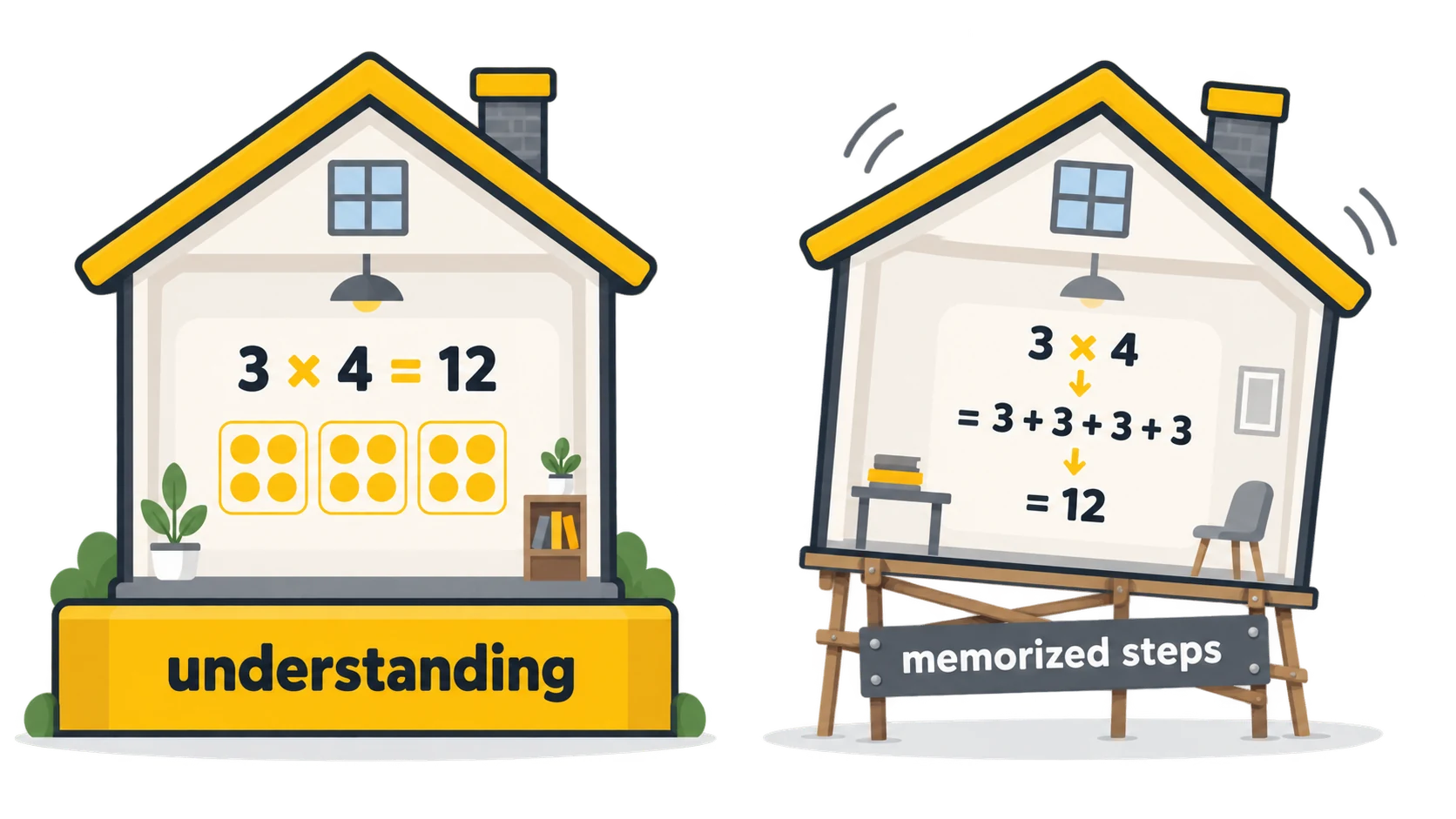
The first is procedural: they've memorized a sequence of steps. "To do this kind of problem, you do this, then this, then this." Follow the recipe, get the answer. The child can execute the procedure flawlessly — and have no idea what any of it actually means.
The second is conceptual: they genuinely understand what's happening and why. They know what the numbers represent, why the steps work, and what the answer actually means. The procedure isn't a memorized recipe — it's something they could almost reconstruct themselves, because they understand the logic beneath it.
Both produce correct answers on a straightforward test. That's the problem. On the surface, procedural and conceptual understanding look identical. A right answer is a right answer. The test can't tell you which kind of thinking produced it.
But underneath, they couldn't be more different. One is a house built on a foundation. The other is a house built on scaffolding — it stands up fine until the ground shifts, and then it collapses.
Why Right Answers Can Hide a Shaky Foundation
So why do so many kids end up with procedural knowledge but no real understanding? It's not their fault, and it's usually not the teacher's fault either. It's structural.
Math classes often move fast, with a lot of material to cover and a test looming. The quickest way to get a whole class producing right answers before the test is to teach the procedure: here are the steps, practice them, reproduce them on the exam. Understanding why takes longer, so it often gets skipped in the rush.
Kids, being smart, adapt. They realize they don't actually need to understand — they just need to follow the steps to get the mark. So they memorize the recipe, pass the test, and move on. The grade looks great. The understanding was never built.
And there's a subtle psychological trap here too, sometimes called the illusion of understanding. When a child can successfully follow steps and get right answers, it feels like understanding — to them, to the teacher, and to you. Everyone's fooled, because the visible evidence (correct answers) points to comprehension that isn't actually there. The gap stays hidden until a problem finally demands real understanding — and by then, the class has moved on to something new.
The Real Cost: Why This Catches Up With Kids
Here's why this matters so much more in math than in almost any other subject: math is relentlessly cumulative.
Every concept builds directly on the ones before it. You can't truly understand fractions without understanding division. You can't understand algebra without truly understanding what an equation represents. You can't understand calculus without a solid grasp of the algebra beneath it.
When a child gets right answers without real understanding, they carry an invisible gap forward into everything built on top of it. And math never stops building. So the gap doesn't stay the same size — it compounds:
- In the current unit, memorized steps are enough. The child copes.
- In the next unit, which assumes real understanding of this one, the steps don't quite transfer. The child struggles a little.
- A few units later, so much has been built on the missing foundation that the child is genuinely lost — and nobody can figure out why, because "they were doing so well earlier."
This is why so many kids seem to "suddenly" struggle with math around algebra, or hit a wall in a later course. It rarely happened suddenly. The gaps were forming for years, hidden behind right answers, until the accumulated weight finally became too much for the missing foundation to hold.
The child who memorized their way through arithmetic hits a wall in Algebra 1. The one who scraped through algebra procedurally struggles in Algebra 2, Geometry, and later Precalculus — not because they can't do math, but because the understanding was never actually there to build on.
How to Tell If Your Child Truly Understands
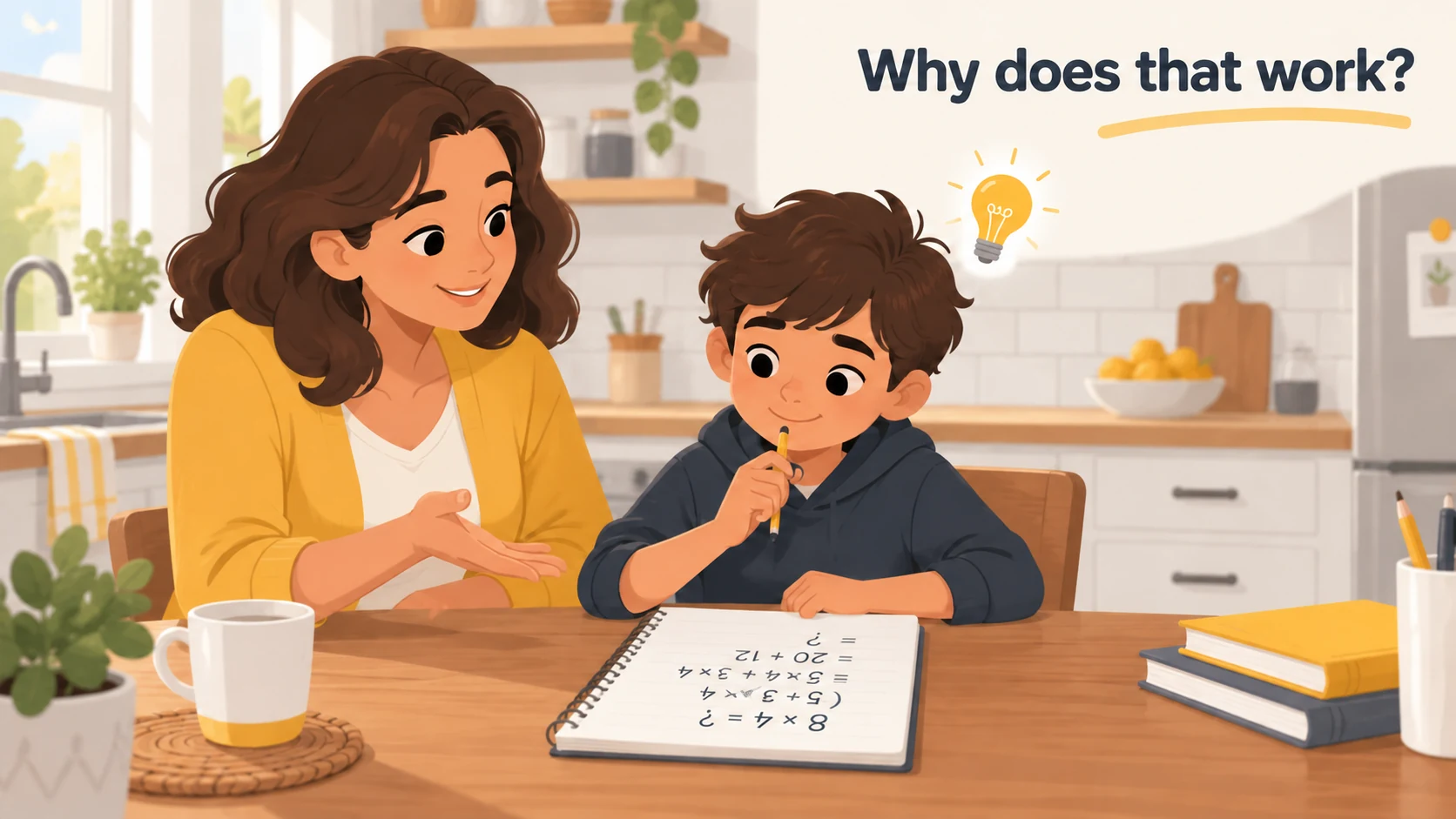
The good news: the gap between answers and understanding is easy to detect once you know how to look. You don't need to be a math expert — you just need to ask the right kinds of questions. Right answers alone won't reveal understanding, but these will:
Ask them to explain why. Not "what's the answer?" but "why does that work?" A child with real understanding can explain the reasoning. A child running on memorized steps will say "I don't know, that's just how you do it" — the single clearest sign of procedural-only knowledge.
Ask them to teach it to you. Have them walk you through the concept as if you'd never seen it. Genuine understanding can be taught to someone else. Memorized steps fall apart the moment they have to be explained rather than just performed.
Change the problem slightly. Give them the same concept in an unfamiliar form, or worded differently. A child who understands adapts easily. A child relying on a memorized pattern gets stuck the instant the pattern changes — because the surface changed and they only ever learned the surface.
Ask what the answer means. They solved for x — but what does that number actually represent? Real understanding connects the answer back to meaning. Procedural knowledge stops at the number.
Watch how they handle being stuck. A child with conceptual grounding can reason their way toward an approach even on an unfamiliar problem. A child with only memorized steps has nowhere to go the moment the recipe runs out.
Our downloadable turns exactly these prompts into a simple tool you can use with your child on any math topic — a quick way to see whether the right answers are backed by real understanding or hiding a gap.
What Real Math Mastery Looks Like
So what are we actually aiming for? Not just right answers — mastery.
A child with genuine math mastery can do far more than reproduce steps. They can:
- Explain the reasoning behind what they're doing, in their own words
- Apply the concept to new, unfamiliar problems they've never seen before
- Connect it to related ideas and to what it actually means
- Reconstruct the approach even if they forget the exact procedure, because they understand the logic
- Retain it, because understood knowledge sticks in a way memorized steps never do
This is durable, transferable, real. It doesn't evaporate after the test. It doesn't collapse when the problem changes shape. And crucially, it becomes a solid foundation for everything built on top of it — so instead of gaps compounding into struggle, understanding compounds into confidence.
That's the difference mastery makes. A child who truly understands each concept doesn't hit a mysterious wall later, because there's no hidden weakness waiting to give way. Each new topic lands on solid ground.
Why Building Understanding Takes Individual Attention
Here's the honest challenge: building genuine understanding — rather than just drilling procedures — is hard to do in a group setting.
Detecting the gap requires watching an individual child think, asking them why, and noticing the exact moment their reasoning breaks down. Closing the gap requires explaining a concept in the specific way that child needs — and if the first explanation doesn't land, trying a second, a third, connecting it to something they already understand. None of that is possible when one teacher is managing a whole classroom racing toward the next test.
This is precisely what one-to-one attention makes possible. A dedicated mentor can:
- See exactly where understanding breaks down — not just that an answer is wrong, but why the child's thinking went astray
- Ask the why questions constantly, so a child can never quietly slip into memorize-and-move-on
- Explain in whatever way that specific child needs, adapting until genuine understanding clicks
- Refuse to move on until the concept is truly understood, not just performed — so no hidden gaps get carried forward
This is the difference between a child who looks like they're doing well and a child who genuinely is. You can see how our mentors build real understanding on our How It Works page.
The Bottom Line
A right answer is not proof of understanding. It's one of the most reassuring-looking, and most misleading, signals in your child's entire education.
Kids can — and constantly do — get math answers right by memorizing steps they don't understand. It works fine on straightforward tests, so the gap stays hidden. But math is cumulative, and those hidden gaps compound quietly until, one day, your child seems to "suddenly" struggle. It was never sudden. The foundation was missing all along.
The solution isn't more drilling of procedures. It's building genuine mastery — real, durable understanding your child can explain, apply, and build on. So the next time your child gets a math answer right, ask them one simple question: "Why does that work?"
Their answer will tell you far more than any grade ever could.
Check What's Really Behind the Right Answers
Right answers can hide gaps — but you can uncover them in minutes. with your child on any math topic to see whether their correct answers are backed by real understanding or memorized steps.
If you notice the same gaps coming up again and again, that's worth a conversation. Discuss recurring gaps with our learning team — we'll help you see exactly where your child's understanding stands and how to build the real mastery that lasts.
Explore our math mentorship: Algebra 1 · Algebra 2 · Geometry · Precalculus · How It Works
Building real math mastery — not just right answers — for families in Bloomington, Monroe County, and around the world.
Related Articles

Algebra 1 Readiness Checklist: Skills to Check Before the Course Begins
Check six essential skill areas before Algebra 1 begins, from fractions and negative numbers to variables and logical reasoning.
Read More
Why Your Gifted Child is Bored in Coding Class (And What To Do About It)
The heartbreaking pattern repeats worldwide: a brilliant nine-year-old masters programming concepts in two weeks, then sits through ten more weeks of review. Here's why age-based curricula systematically fail gifted learners.
Read More
The Portfolio Advantage: Why GitHub Profiles Beat Certificates in College Applications
Admissions officers increasingly check GitHub. A student with 3+ years of commit history and original projects stands out far more than a stack of identical course completion certificates.
Read MoreReady to Start Your Child's Journey?
Book a free 30-minute strategy call to discuss your child's potential.