
Parents constantly ask us: "What should my child be learning at this age?" The honest answer is that age is a poor predictor of readiness. Skill is what matters. But families do need a general roadmap to set expectations, so here's ours.
Ages 6–8: Logic Foundations
At this stage, no syntax yet. Visual logic puzzles. Pattern recognition games. Basic sequencing—"if this happens, then this happens." Storytelling-based problem decomposition. The goal is making logical thinking feel natural and fun, building the cognitive scaffolding that will support real coding later.
Ages 9–11: Visual Programming and First Code
Block-based programming bridges logic into structure. Students start to build small interactive projects—games, animations, simple websites. This is where they first encounter variables, loops, and conditionals as concepts they can actually use to make something happen.
Toward the end of this stage, advanced students transition to text-based code (often Python or JavaScript) on real projects.
Ages 12–14: Real Software Development
Full-stack web development becomes accessible. Students build genuine applications—task managers, community tools, small games—with proper version control, documentation, and deployment. Algorithmic thinking deepens. Debugging becomes a skill, not a frustration.
This is also the stage where the Junior CTO mindset takes root. Students start identifying problems worth solving, planning before they code, and architecting their projects.
Ages 14–15+: Specialization and University-Level Work
Students choose depth: AI and machine learning, full-stack engineering, game development, mobile apps, cybersecurity. They tackle university-level computer science coursework (Harvard's CS50 is a common one) and earn industry certifications. Their portfolios mature into something that meaningfully impacts college applications.
The Honest Caveat
These age bands are averages. We've seen 9-year-olds doing genuine algorithm design and 14-year-olds still building strong logic foundations. Neither is wrong. The roadmap is a guide, not a deadline. The right next step is always the one calibrated to your child—not their age.
Related Articles
Why Your Gifted Child is Bored in Coding Class (And What To Do About It)
The heartbreaking pattern repeats worldwide: a brilliant nine-year-old masters programming concepts in two weeks, then sits through ten more weeks of review. Here's why age-based curricula systematically fail gifted learners.
Read More
Why We Teach Logic Before Syntax
Most coding programs start with Python or JavaScript syntax. Rite Tutor starts with how to think. Logic is permanent — languages change. Here's the philosophy and the science behind it.
Read More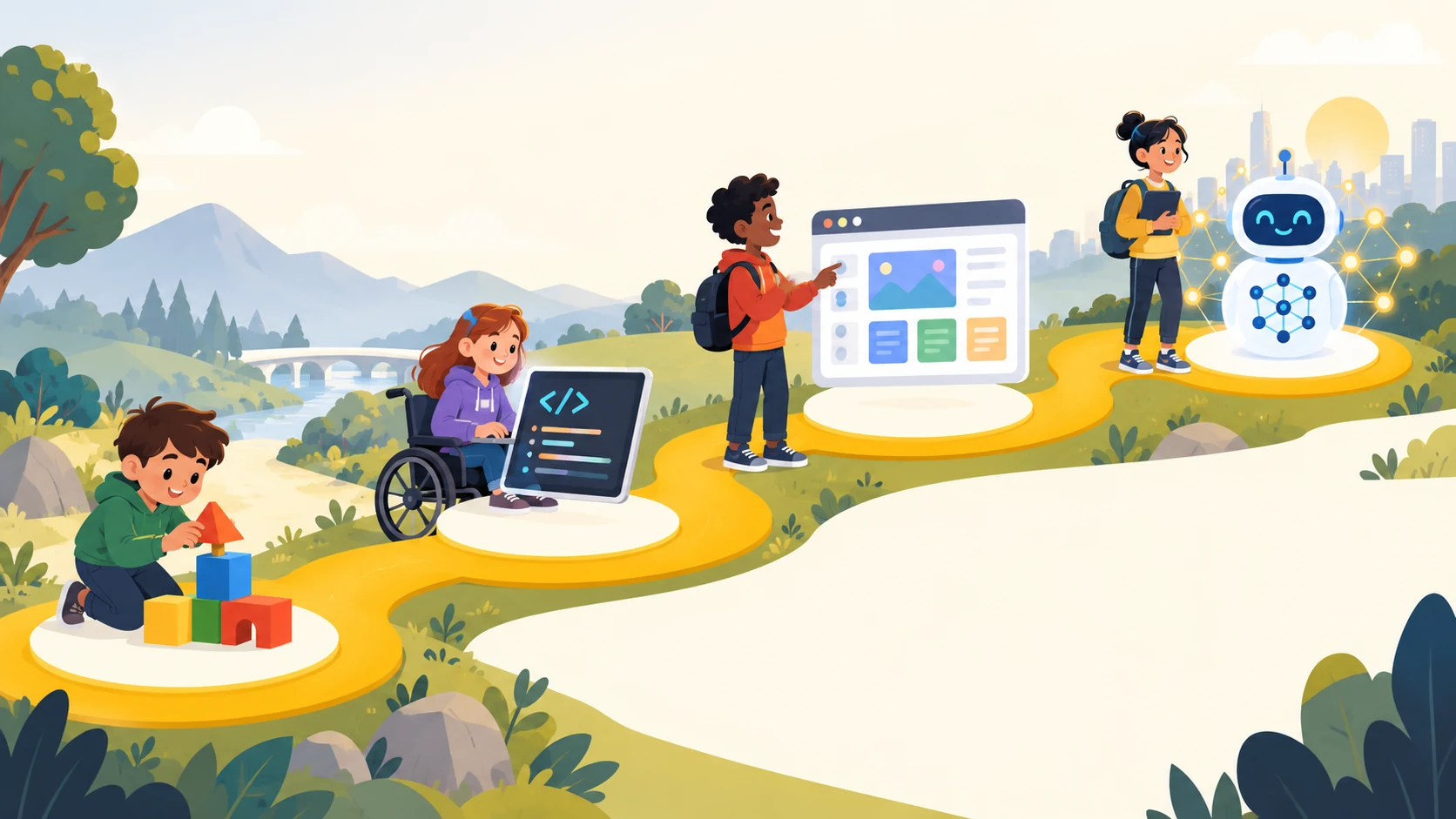
Coding Roadmap for Kids Ages 6–15: Choose by Skill, Not Just Age
Find your child’s next coding step by readiness, from visual blocks and Python to web development, full-stack projects, and AI.
Read MoreReady to Start Your Child's Journey?
Book a free 30-minute strategy call to discuss your child's potential.