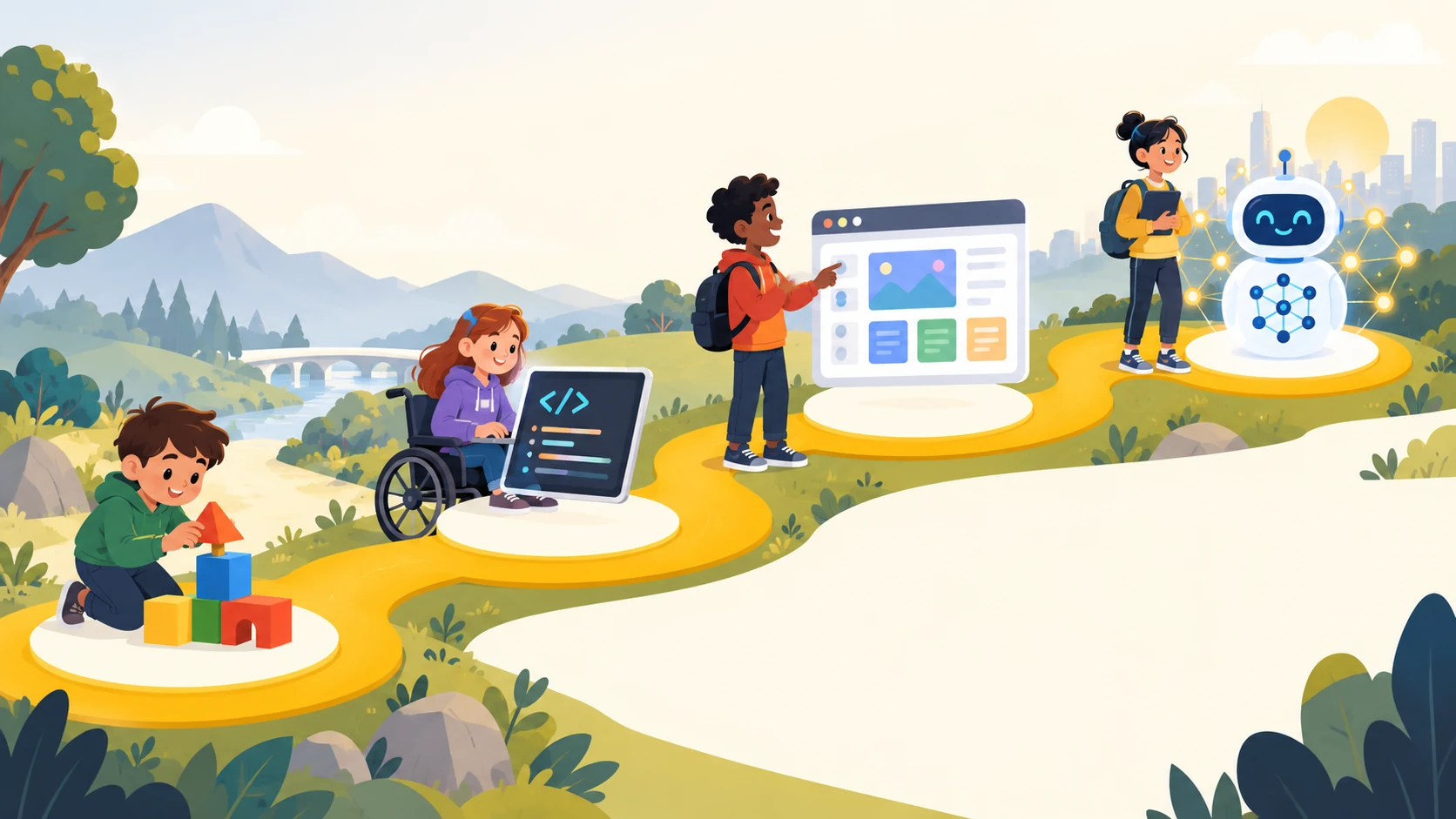
If you've searched for a coding roadmap for kids, you've probably seen the same thing everywhere: a neat chart that says ages 6–8 do this, ages 9–11 do that, ages 12–15 do the other. Tidy. Simple. And quietly wrong.
Because here's the truth every experienced mentor knows: two children of the exact same age can be worlds apart in coding readiness. One ten-year-old is ready to write real code in a professional language. Another ten-year-old is still building the foundations with visual blocks — and that's completely fine. Age tells you how many birthdays a child has had. It tells you almost nothing about what they're ready to learn next.
So this roadmap is built differently. Instead of sorting your child by their birthday, it sorts by skill and readiness — meeting them exactly where they genuinely are and showing the natural path forward from there. Whether your child is 6 or 15, a total beginner or already writing code, you'll find where they fit and what comes next.
Let's map the real journey from first steps to genuine full-stack and AI skills — the skill-based way.
Why Age-Based Roadmaps Fail Kids
Before the roadmap itself, it's worth understanding why the usual age-based approach holds so many children back — because avoiding that trap is the whole point.
Age-based progression assumes every child of a given age needs the same thing at the same time. But coding readiness depends on far more than age:
- Prior experience. A child who's been tinkering for two years is in a completely different place than one just starting, regardless of age.
- Reading and typing fluency. Moving to text-based code depends on comfort with reading and typing, which varies enormously.
- Logical and abstract thinking. Some kids grasp abstract concepts like variables and functions early; others need more concrete grounding first.
- Interest and motivation. A deeply motivated child races ahead; a reluctant one needs a different on-ramp entirely.
When you ignore all of this and sort purely by age, two bad things happen. Advanced kids get bored — stuck relearning things they mastered long ago, slowly concluding that coding is tedious. And kids who need more foundation get lost — pushed into material they're not ready for, quietly deciding they're "not a coding person."
Neither outcome is about ability. Both are about bad placement. A skill-based roadmap fixes this by starting from one simple question: not how old is this child? but what is this child genuinely ready for right now? You can see how this philosophy runs through everything we do on our Learning Pathways page.
How to Find Your Child's Real Starting Point
Rather than looking up your child's age, look at what they can already do. Read the four stages below and find the one that best matches your child today. That's their real starting point — whatever their age.
A few honest signals to help you place them:
- Can they read and type comfortably? If not, they'll likely start with visual, block-based coding regardless of age.
- Do they understand basic logic — the idea of steps in order, "if this, then that," repeating actions? This readiness marks the move toward real code.
- Have they coded before, and how did it go? Past experience and enthusiasm move a child further along the path.
- Are they bored by what they're currently doing? Boredom is often the clearest sign a child is ready to level up.
Our downloadable walks you through these signals in detail, so you can pinpoint your child's stage with confidence. But even a rough placement from the stages below will get you close.
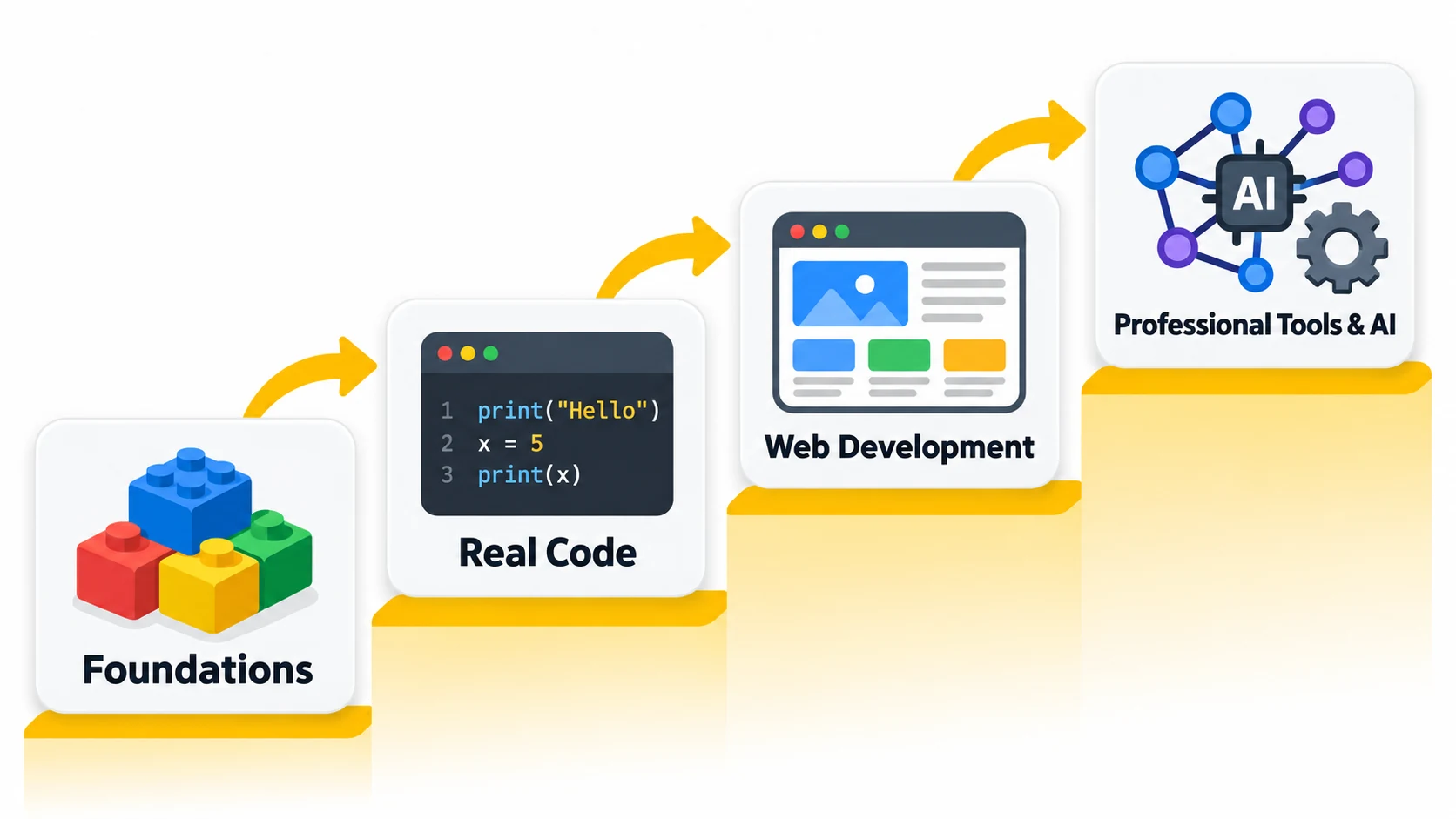
Stage 1: Foundations — Building the Thinking (Typical Entry: Early Beginners)
Who's here: Children brand new to coding, often those still developing reading and typing fluency. Many start here around ages 6–8, but a slightly older beginner belongs here too — and there's no shame in that. Everyone starts at the foundations.
The goal of this stage: Build core computational-thinking concepts without the friction of typing and syntax. At this stage, we want the child to fall in love with making things and to internalize the fundamental logic of coding.
What they learn:
- Sequencing — that instructions happen in a specific order
- Loops — repeating actions efficiently
- Events — making things happen in response to actions ("when I click this…")
- Simple conditionals — the beginnings of "if this, then that" logic
- Problem decomposition — breaking a goal into small steps
How they learn it: Through visual, block-based coding, where children snap together colorful command blocks instead of typing. This removes the frustration of syntax errors and lets them focus entirely on logic and creativity.
What they build: Animated stories, simple maze and obstacle games, interactive quizzes, and playful projects where a character responds to clicks. Small, complete, satisfying creations they're proud to show off.
Signs they're ready to move on: They breeze through block projects, they're getting bored, they can read and type reasonably well, and — often — they start asking how "real" coding works. That's the cue for Stage 2.
Stage 2: Real Code — The Leap to a Professional Language (Typical Entry: Ready Beginners)
Who's here: Children who've mastered the foundational concepts and are ready to type real code. Many reach this stage around ages 9–12, but a motivated, logically-minded younger child can arrive early, and that's wonderful.
The goal of this stage: Make the pivotal leap from visual blocks to a real, professional programming language — Python — and discover that they can write genuine code like the professionals do.
Why Python? Because it was designed to be readable and beginner-friendly, reading almost like plain English, while being a genuine professional language used in everything from web development to artificial intelligence. Nothing your child learns here will need to be "unlearned" later — it's the real thing, scaled to their level. This is the heart of our Python Quest pathway.
What they learn:
- Variables — storing and using information
- Functions — writing reusable blocks of code
- Loops and conditionals in real syntax — the concepts from Stage 1, now written as actual code
- Debugging — reading errors and systematically fixing them
- Logical problem-solving — breaking real problems into codeable steps
What they build: Number-guessing games with hints, text adventures where choices shape the story, quiz apps on topics they love, and practical little tools — calculators, converters, trackers. Real programs that genuinely work.
Why this stage matters so much: This is where a child stops "playing at coding" and starts thinking of themselves as a real programmer. The transition needs support — typing and syntax can frustrate a child at first — which is exactly why guidance matters most here. Done well, it's one of the most empowering leaps in the whole journey.
Signs they're ready to move on: They can write basic Python programs independently, they debug with growing confidence, and they're hungry to build bigger, more visual, more ambitious things — things other people can actually use.
Stage 3: Building Real Applications — Web Development (Typical Entry: Confident Coders)
Who's here: Children fluent in the fundamentals of real code who are ready to build applications other people can see and use. Many reach this around ages 11–14, but readiness — not birthday — is what places them here.
The goal of this stage: Move from standalone programs to real, interactive applications that live on the web. This is where coding becomes visible, shareable, and genuinely impressive.
What they learn:
- The building blocks of the web — structuring content and styling it with design choices of their own
- Interactivity — making pages respond to what users do
- Design and user experience — thinking about the human on the other side of the screen
- Connecting the pieces — how the parts of a real application fit together
Explore this stage on our Web Development pathway.
What they build: Personal websites and portfolios, interactive tools and apps, more sophisticated games, and projects that solve real problems in their own lives — something their club, family, or school could actually use. These are the projects worth putting in a real portfolio.
Why this stage matters: This is where a child crosses from "writes code" to "builds software." Their creations become real, usable, and shareable — a genuine portfolio of work they can show, explain, and be proud of. That portfolio has real long-term value, from college applications to future opportunities.
Signs they're ready to move on: They can build a working web application and take on genuine complexity, and they're ready for professional tools that make ambitious projects possible.
Stage 4: Professional Tools and AI — Full-Stack and Beyond (Typical Entry: Advanced Young Developers)
Who's here: Experienced young coders ready for the tools and concepts professional developers use. Many reach this around ages 13–15, but a truly advanced younger child who's progressed quickly belongs here too.
The goal of this stage: Work with genuinely professional tools and frameworks, build sophisticated full-stack applications, and step into the most exciting frontier of all — artificial intelligence.
What they learn:
- A modern professional framework for building polished, interactive applications — the kind used in real industry. This is the focus of our React.js pathway.
- Full-stack thinking — designing the interface, writing the logic, and handling data, then wiring them all together
- The foundations of artificial intelligence — using Python to explore how machines learn, make predictions, and power the technology reshaping the world. Our AI with Python pathway opens this door.
- Real engineering practices — planning, version control, and iterating on real feedback
What they build: Full-stack web applications with real features and stored data, polished interactive projects built with professional frameworks, and their first genuine AI-powered programs. Portfolio-defining work that genuinely impresses.
Why this stage matters: This is where "kid who codes" becomes "young person with real, professional, future-ready skills." The projects built here are the kind that strengthen college applications, spark genuine career direction, and prove real capability. A child who reaches this stage isn't preparing for a technical future — they're already living it.
The Roadmap Isn't a Race
One vital thing to hold onto as you look at these four stages: this is a journey, not a race.
The goal is never to rush your child through the stages as fast as possible. It's to keep them at their perfect edge at every point — challenged enough to grow, supported enough to stay motivated, and genuinely engaged the whole way. A child who moves through the foundations thoroughly and joyfully will go far further than one pushed ahead before they're ready.
Two children might travel this roadmap at very different speeds, and both can arrive at genuine mastery. Speed isn't the measure. Depth, confidence, and love of building are. The roadmap simply shows the direction — the pace should always follow the child.
And notice what disappears when you think this way: the anxiety about whether your child is "behind." There is no behind. There's only your child's current stage and the next step forward from it. That's the freedom a skill-based roadmap gives you.
Why Skill-Based Progression Needs the Right Teaching Model
Here's the catch that ties everything together: a skill-based roadmap only works if the teaching can actually adapt to each child's stage. And that's precisely where most coding education falls down.
A group class can't do it. With fifteen kids at fifteen different stages, an instructor has no choice but to teach to the middle — boring the advanced kids and losing the beginners, the exact problem age-based roadmaps create. A self-paced app can't do it either; it can't tell when your child is stuck, ready to advance, or quietly falling behind.
Genuinely skill-based progression requires one-to-one mentorship. Only a dedicated mentor can accurately assess where your child truly stands, place them at the right stage, and then continuously adjust — moving forward the moment they've mastered something, slowing down the moment they need more support. The roadmap becomes real only when someone is walking it with your specific child, at your specific child's pace.
That's exactly how our mentorship works: we assess each child's genuine starting point, place them precisely on this roadmap, and guide them forward one perfectly-calibrated step at a time. You can browse the full set of pathways on our Courses page.
Putting It All Together
So here's the roadmap, at a glance — sorted by readiness, not by birthday:
- Stage 1 — Foundations: Core thinking through visual blocks. Build stories, games, and quizzes.
- Stage 2 — Real Code: The leap to Python. Write genuine programs and tools.
- Stage 3 — Web Development: Build real, shareable applications and a portfolio.
- Stage 4 — Professional Tools and AI: Full-stack projects, professional frameworks, and first steps into artificial intelligence.
Every child starts somewhere on this path, and every child can move forward from there. A 7-year-old and a 14-year-old, a total beginner and an experienced coder — all of them have a clear next step. The only question that matters is: where is your child right now, and what's the next challenge that will genuinely stretch them?
Answer that honestly, meet your child exactly there, and the whole journey opens up.
The Bottom Line
The best coding roadmap for your child isn't the one that matches their age. It's the one that matches their readiness.
Age-based charts hold kids back — boring the advanced ones and overwhelming the beginners — because they measure the wrong thing. A skill-based roadmap meets each child exactly where they genuinely are and shows the natural path forward: from the foundations of computational thinking, to real code in Python, to building real web applications, to professional tools and artificial intelligence.
Your child has a place on this path today, and a clear next step from it. There's no "behind," no race, and no one-size-fits-all. There's just your child, their real current level, and the next challenge that will help them grow.
Find that starting point, meet them there, and watch how far they can go.
Find Your Child's Perfect Starting Point
Not sure exactly where your child fits on the roadmap? That's what we're here for. to pinpoint your child's stage — then let us give you a personalized starting-path recommendation built around their real skill level and interests.
Get your personalized starting-path recommendation and give your child a coding journey that begins exactly where they are.
Explore the full journey: Learning Pathways · Courses · Python Quest · Web Development · React.js · AI with Python
Skill-based, one-to-one coding mentorship for kids ages 6–15 — in Bloomington, Monroe County, and around the world.
Related Articles

Why Your Gifted Child is Bored in Coding Class (And What To Do About It)
The heartbreaking pattern repeats worldwide: a brilliant nine-year-old masters programming concepts in two weeks, then sits through ten more weeks of review. Here's why age-based curricula systematically fail gifted learners.
Read More
Why We Teach Logic Before Syntax
Most coding programs start with Python or JavaScript syntax. Rite Tutor starts with how to think. Logic is permanent — languages change. Here's the philosophy and the science behind it.
Read MoreThe Complete Coding Roadmap for Kids Ages 6 to 15
What should a 7-year-old learn? An 11-year-old? A 14-year-old? A skill-based roadmap from first logic puzzles to university-level coursework.
Read MoreReady to Start Your Child's Journey?
Book a free 30-minute strategy call to discuss your child's potential.